
The time when deepfakes could be dismissed as technological curiosities or occasional pranks is over. In a WIPO discussion, Professor Anderson Rocha reframed deepfakes and the technologies around them as “Synthetic Realities.” They are not simply technologies for making convincing fakes, but forces that change reality itself: society, law, and politics as a whole.
The actual patterns of harm show that this diagnosis is no exaggeration. Unfortunately, what deepfake technology has increased most rapidly is not more sophisticated video, but harmful material such as sexually exploitative content and real-time social-engineering crimes such as voice impersonation and fabricated video interviews. Authentication systems based on faces and voices face a fundamental threat. Synthetic news photographs and fictional experts spread disinformation and influence public opinion, while courts now have to ask, “What counts as authentic evidence?”
As the problem became clear, countries began responding. Interestingly, although they faced the same problem, they introduced different forms of regulation. This article looks in turn at how the EU, the United States, Denmark, China, and South Korea have approached the same issue in different ways.
🇪🇺 The EU — reinterpreting existing regulation
Before making new laws, we need to ask whether existing frameworks can cope. Professor Sebastian Schwemer examined in particular whether “content moderation” as defined in the Digital Services Act (DSA), a comprehensive content-regulation framework, could also work for synthetic media. Content moderation is the process by which platforms filter out inappropriate content.
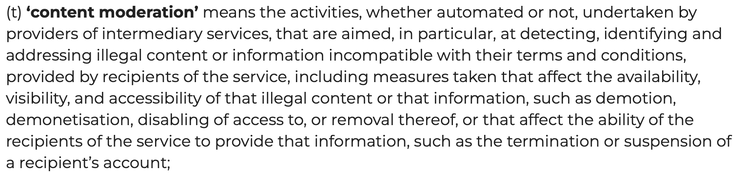
Article 3(t) of the DSA defines content moderation as activities undertaken by intermediary-service providers, whether automated or not, to detect, identify, and address illegal content or information incompatible with their terms and conditions. It broadly lists measures including demotion to reduce visibility, demonetisation, disabling access, removal, and even suspension or termination of the publisher's account. Compared with the former E-Commerce Directive, this significantly expands the scope of what can be taken down and how.
The problem is that this framework is insufficient for direct application to deepfakes. First, synthetic content is not inherently illegal (Synthetic ≠ Illegal). The DSA targets content that is illegal or violates terms of service, but much synthetic content fits neatly into neither category. Second, and more fundamentally, the standard for deciding what to remove breaks down. In an environment where “real things that look fake” and “fake things that look real” coexist, even the yardstick for deciding whether there has been too much or too little removal disappears.
That does not mean the DSA ignores deepfakes. Although it does not use the term “deepfake,” Article 35(1)(k) requires very large online platforms (VLOPs) to distinguish generated or manipulated images, audio, and video that appreciably resemble existing people, objects, places, or events and falsely appear authentic or truthful by using “prominent markings,” and to provide a function enabling users to report such content themselves.
A similar intention appears in the transparency obligations under Article 50 of the EU AI Act. These labeling duties, however, encounter the same question that South Korea faces, as we will see later: if a malicious user strips off the label and distributes the content, who bears responsibility, and how far does it extend?
Nevertheless, the EU's real strength lies in procedure rather than content. The DSA's procedural safeguards, such as human review, avenues for appeal, and explanations of the reasons for action (including Article 14), become essential when it is difficult to determine what is real. Ultimately, the EU's remaining task is not to improve detection accuracy but to decide where to intervene: at the platform where content is generated or at the distribution stage; how to handle prompts, outputs, and reuploads; and what to moderate, through which procedures, and under whose responsibility.
🇺🇸 The United States — creating new rights
The United States begins from a different premise than the EU. As Professor Ben Sheffner explains, the US discussion starts from the view that “digital replica rights” cannot simply be squeezed into existing publicity-rights or copyright frameworks. US publicity-rights law was originally designed for advertising and merchandising and broadly exempts expressive works. This has left a regulatory gap when generative AI creates new performances or voices of real actors and singers.
Industry, rather than government, moved first. The SAG-AFTRA agreement reached after the 2023 actors' and broadcasters' strike served as a kind of interim norm. It distinguishes digital replicas created through employment from independently created replicas. This was less a technological distinction than a compromise to organize transaction costs and the allocation of responsibility. It sought to recognize actors' control while retaining existing production practices.
Building on this, the No Fakes Act is being pursued as federal legislation. The bill creates a new federal property right over realistic digital replicas, lasting for 70 years after death and capable of inheritance and transfer. It also imposes responsibility on platforms and AI-tool providers across the entire process of creation and distribution.
There are, however, two main issues. First, although the bill provides exceptions for public-interest uses such as news, biography, criticism, scholarship, and satire, the conditions for applying them are unclear. Second, a structure requiring platforms to remove content immediately after notification by a rights holder and automatically block reuploads of similar content may lead to excessive blocking.
Entertainment-industry and artist groups point to actual harms such as sexual deepfakes and synthetic-voice fraud in demanding clear federal protection. Free-expression advocates, by contrast, worry that allowing lawsuits based on infringement alone, without proof of specific harm, could chill criticism, satire, and historical representation. Documentary makers and other creators fear an environment in which expression ultimately requires permission, while smaller platforms and the open-source ecosystem face another burden because they cannot readily support large-scale filtering infrastructure.
🇩🇰 Denmark — extending copyright
Denmark is among the countries that have moved fastest and most boldly. The Danish amendment bill introduced by Professor Stina Teilmann-Lock creates two new rights on the premise that deepfakes should be handled within the existing copyright system, taking effect on March 31, 2026.
The first is a right protecting performers. It requires consent when realistic digital imitation reproduces a performer's artistic performance. Because its scope includes performances regardless of whether they qualify as works, however, some see it as unsettling the very definition of a “work” that has traditionally underpinned copyright protection.
The second is a right protecting against imitation of a person's appearance. It protects everyone, regardless of nationality, against content that realistically imitates a natural person's physical and personal characteristics. Parody, satire, and social criticism are excepted, but even those exceptions are restricted when there is a risk of serious harm from disinformation.
Through this legislation, Denmark is trying to bring together grounds previously scattered across data-protection, marketing, and criminal law into one clear standard that platforms can use to take down deepfakes. Two challenges remain: 1) definitions of core concepts such as “artistic performance” and “realistic imitation” are difficult to fix as technology develops, and 2) it is uncertain whether these new rights will actually become a priority given the limited capacity of the police and judicial authorities.
Finally, Professor Teilmann-Lock added an intriguing possibility: rather than merely suppressing deepfakes, this system could bring new markets, such as avatars and synthetic celebrities, within an institutional framework.
Continued in the next article.