
In the previous article, we saw how the EU, the United States, and Denmark address the same deepfake problem in different ways. This time, I will turn to East Asia to examine China and South Korea, and conclude by considering what these national differences tell us.
🇨🇳 China — holding platforms responsible
Before confronting synthetic media in earnest, China had already discussed who should be regarded as the owner of AI-created works. In recent cases concerning AI-generated content (AIGC)[1], Chinese courts have held that AI-generated material can qualify for copyright protection if a human used AI as a tool and made creative choices. Rather than excluding AI output wholesale, this approach assesses cases individually according to the human contribution. It is significant as an attempt to identify creativity even when authorship or provenance is unclear.
[1] Li (李) v. Liu (劉) — Beijing Internet Court, (2023)京0491民初11279号, November 27, 2023. The defendant used without permission an image that the plaintiff had generated with Stable Diffusion and posted on social media. The court found that the plaintiff had invested intellectual effort in selecting and arranging prompts, setting parameters, and choosing images, thereby expressing aesthetic choices and individual judgment. Because this was essentially a person creating with a tool, it recognized the image as an original work of fine art and found infringement (damages: RMB 500). The decision is regarded as China’s first significant civil judgment recognizing copyright in AI-generated material. It was, however, a case-specific determination rather than a general rule; another lower court in China has denied copyright protection to a design made with Midjourney.
Meanwhile, when it comes to deepfakes themselves, China puts platform responsibility at the forefront. A representative example is the Guangzhou Internet Court’s Ultraman case, which held a generative AI service provider liable for infringement[2].
[2] Ultraman case — Guangzhou Internet Court, (2024)粤0192民初113号, judgment of February 8, 2024. The plaintiff, which held the exclusive Chinese license for the Ultraman series, sued a provider of a text-to-image generative AI service. The court held that images generated by the service were substantially similar to Ultraman and infringed the rights of reproduction and adaptation. It ordered damages of RMB 10,000, finding that the provider had failed to fulfill reasonable duties of care, including establishing a reporting mechanism and labeling AI-generated content. The case attracted attention as the first to recognize a generative AI service provider’s liability for copyright infringement.
🇰🇷 South Korea — responding with penalties and labeling requirements
Whereas the three Western jurisdictions mainly sought to create new rights and draw boundaries between those rights and freedom of expression, South Korea chose another approach. Discussion began with protecting victims and imposing penalties, rather than allocating rights.
Elections provide a clear example. Article 82-8 of the Public Official Election Act, introduced in late 2023, entirely prohibits anyone from producing, editing, distributing, screening, or posting, for election campaigning, virtual audio, images, or videos created using AI or similar technology that are difficult to distinguish from reality, during the period from 90 days before election day through election day itself. Before that 90-day period, such content may be used if labeled as AI-generated; from 90 days before the election onward, it is prohibited regardless of labeling. The 90-day threshold was based on the judgment that recovering from the damage caused by false information once it has spread takes at least three months. The June 3, 2026 local elections were effectively the provision’s first test.
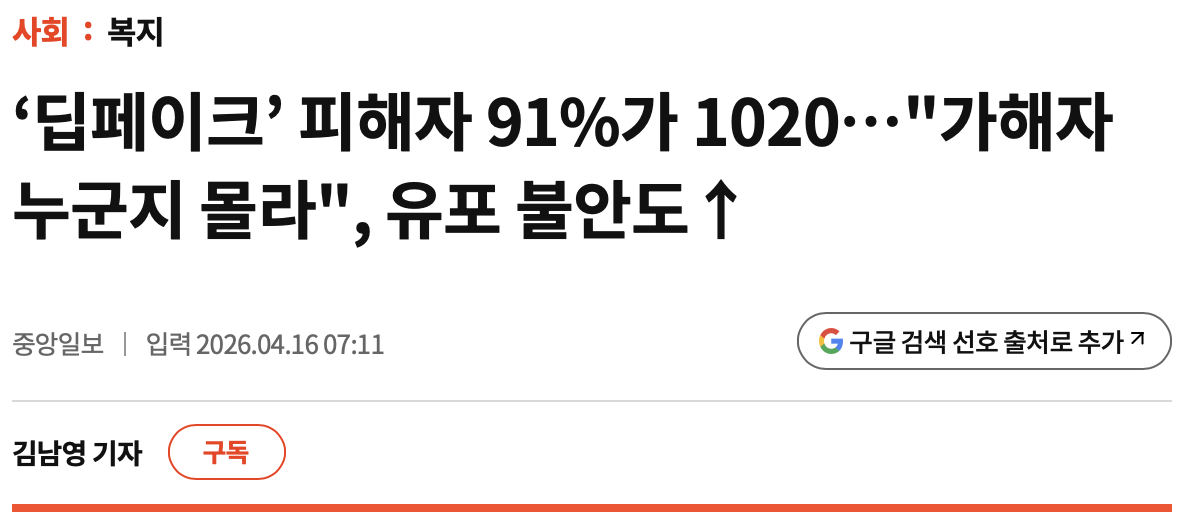
Article 14-2 of the Act on Special Cases Concerning the Punishment of Sexual Crimes, which penalizes fabricated sexual videos made with deepfake technology, was introduced in 2020 following the Nth Room case and substantially strengthened in October 2024. The maximum sentence for production and distribution rose to seven years’ imprisonment, with a minimum of three years for profit-making offenses. Crucially, production could previously be punished only if there was an intent to distribute; that requirement was removed. A new provision also introduced penalties of up to three years’ imprisonment for merely possessing, purchasing, storing, or viewing such material. These stronger measures followed an explosion in harm over a short period.
New regulations can be swift and forceful because they respond to a clearly identified problem, but their limitation is that they operate only within the particular area they address.
An attempt to fill these gaps is the AI Basic Act, a more general framework that is not tied to a specific crime or sector. This law, which came into force in January 2026, requires generative AI output to carry a label stating that it was made by AI. Instead of pursuing individual sectors one by one, the approach seeks transparency by requiring all generated material to indicate that it is synthetic. Whether this labeling requirement can be a fundamental solution for determining what is real raises many further questions. I will return to those in a later article on the AI Basic Act.
🧭 Closing thoughts
The EU chose to reinterpret its existing regulations; the United States, to create a new property right; Denmark, to extend copyright; China, to place responsibility on platforms; and South Korea, to respond with criminal penalties and labeling. [Discussion of how the five cases converge]
Yet none of these systems has kept ahead of technology. American union agreements, Denmark’s new rights, and South Korea’s criminal law amendments all followed damage that had already occurred. That is inevitable. A world in which institutions lead the way has generally ended less well than the reverse.
If institutions and rules always lag behind technology, the real question may be less “When and how can we complete perfect regulation?” than “How do we manage the situation during that gap?” The five jurisdictions start from different positions but move in similar directions, perhaps not because each has found the right conclusion, but because they are feeling their way toward temporary footholds that will help them endure the delay.
#BetweenTechAndRules #Deepfakes #SyntheticRealities #AIRegulation