
According to the International Energy Agency (IEA), the battery market has grown more than five times in four years from 180GWh in 2020 to 1,100GWh in 2024. The market for electric vehicles, which are the main users of batteries, is growing every year, and it is said that one in four cars sold in 2025 was an electric vehicle.
But where do those batteries go when they expire? According to estimates by the International Commission on Clean Transportation (ICCT), 1.2 million electric vehicle batteries will expire in 2030 and 14 million in 2040. Therefore, the battery industry has no choice but to be interested in the ‘recycling’ of batteries.
The fifth topic of 'The World Seen Through Patents' is batteries, especially the field of battery circulation (battery collection, disassembly, and material recovery).
Last April, the European Patent Office (EPO) and the International Energy Agency (IEA) jointly published a report titled “Battery circularity — Innovation trends for a future source of critical materials.” This is an analysis of the International Patent Family (IPF) in the battery cycling field from 2000 to 2023.
In this article, based on the above report, we have organized the landscape of battery recycling patents into three categories: speed, technology, and subject.
⚡ Patents preparing for the era of waste batteries
First, the speed at which patents are increasing is unusual. According to the report, the international patent family in the battery circulation field increased by an average of 8% per year from 2005 to 2017, but since 2017, it has jumped to an average of 42% per year. During the same period, battery manufacturing technology was 16%, so it is a particularly steep curve even within batteries.
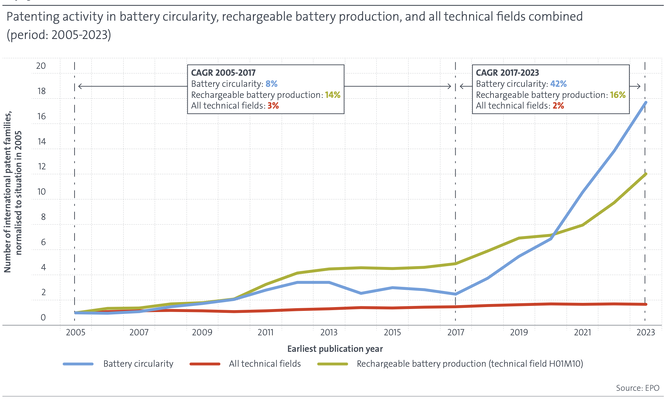
What happened in 2017? First of all, annual sales of electric vehicles exceeded 1 million units for the first time that year. Additionally, between 2013 and 2018, Europe and China introduced laws making manufacturers responsible for what happens to electric vehicle batteries at the end of their lifespan. The report believes that these two factors overlap, creating an incentive to secure recycling methods through patents.
However, the ‘era of waste batteries’ targeted by these patents has not yet arrived. As seen earlier, the number of electric vehicle batteries reaching the end of their life will increase from 1.2 million in 2030 to 14 million in 2040, and the report estimates that the wave will begin in earnest after 2035. Patents are surging ahead of the wave by more than eight years. This is a typical situation where patents accumulate before the market arrives.
🧪 Recycling process and metallurgical technology
So what technologies are being patented? The report divides the recycling process into four stages: collection, sorting/separation, conditioning, and conversion.
The largest concentration of patents is in the final transition phase. Among them, patents related to hydrometallurgy, which dissolves black mass in acid and then selects metals in salt form, increased 15-fold from 40 in 2000-2004 to 661 in 2020-2023, reaching a cumulative 1,023, the largest among single technologies.
The number of pyrometallurgy cases, which create alloys by melting them at high temperatures, also increased from 17 to 208 cases, but at a slightly slower pace. Dry metallurgy is said to have the disadvantage of being able to withstand mixing of raw materials, but using a lot of energy, and lithium falling into slag and having to be recovered separately.
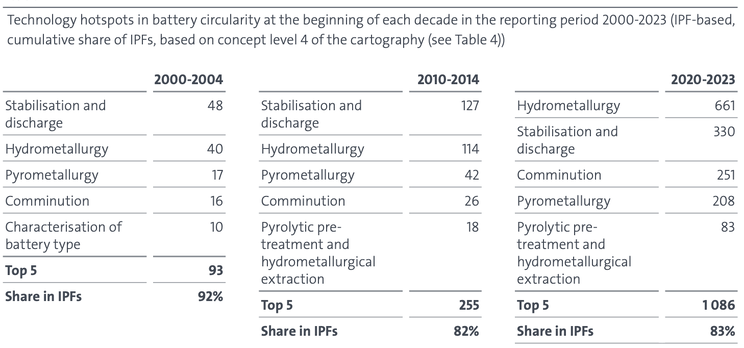
The technologies with the most patents after hydrometallurgy are stabilization and discharge in the collection stage, comminution in the selection and separation stage, pyrometallurgy, and mixing process (wet after heat treatment). Stabilization and discharge remained at the top for all 20 years, and shredding increased 14 times from 16 to 251, making it one of the fastest growing technologies in recent times. According to the report, these top five technologies account for 83% of the international patent family.
🌏 Subject — From Japan and Korea to China
Until 2019, the leaders in patents in this field were Japanese and Korean companies. Toyota and Sumitomo Metal Mines were Japan's leading companies. In Korea, LG, SK Group, POSCO, etc. have secured many patents. In particular, LG not only ranks second in the cumulative international patent family, but is also a rare company that has applied for the entire recycling process, from collection to chemical conversion.
However, the ranking has recently changed. Brunp, the recycling subsidiary of China's CATL, the world's largest battery manufacturer, rose to first place by filing more than twice as many international patent family applications as Toyota, which ranked second, from 2020 to 2023.
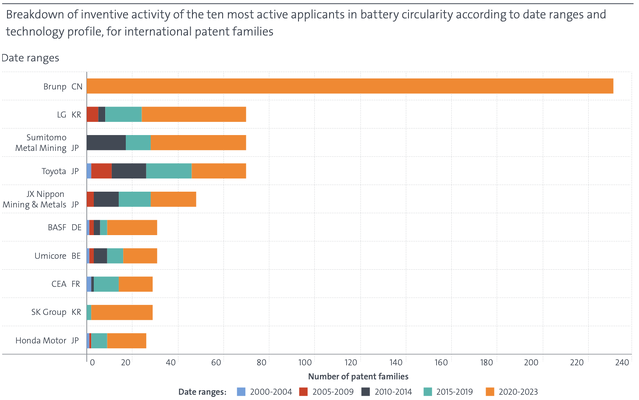
The part to keep an eye on is the raw material for Brunp. According to the report, almost all of the battery raw materials currently being recycled are not waste batteries, but scraps and defective products from the manufacturing process, so-called production scrap. Almost no batteries have reached the end of their lifespan yet. Therefore, it is not the recycling company that holds the largest share of recycled raw materials, but the largest battery factory, and Brunp has been increasing its recycling facilities by receiving scrap from the CATL plant as raw material. According to the report, the recycling facilities Brunp has built so far have a processing capacity of about 5% of the world's total, twice that of the second largest company.
🇪🇺 Europe - Industrial policy disguised as regulation
Europe remained around 20% throughout the analysis period. In particular, they are strong in collection and pre-processing, with 34% of remote handling technologies and 30% of isolation and fixation technologies coming from European applicants. Chemical company BASF and recycling company Umicore are tied for 6th place, and the French Atomic Energy Agency (CEA) is 8th. In the conversion field, Asia's growth rate was faster and its market share fell, but the number of applications in Europe itself increased.
What Europe is lagging behind is not technology, but raw materials. First of all, the minerals that are the starting point for recycling are located outside of Europe. For lithium mining, Australia accounts for more than a third of global production, while for refining, China handles about 70% of lithium and about 80% of cobalt, according to the report. Since most battery factories are located in China, production scrap, which now accounts for almost all recycled materials, also comes from there. Waste batteries from electric vehicles sold in Europe have not yet been released in earnest, and a significant amount of the black mass that has been produced is being exported and disposed of overseas.
So Europe chose to hold on to raw materials with the following regulations.
The above regulations are based on the legal basis for hazardous waste management, but in reality, they are a measure to increase the amount of recycled raw materials to be processed within the EU in response to the problem of Europe's black mass being processed outside the EU. The purpose is to secure raw materials for the regional recycling industry in the coming era of waste batteries.
🧭 Wrapping Up
China controls the supply of 19 of the 20 important minerals refined in the energy sector, and recycling is a technology that each country aims to reduce dependence on. If so, it would be natural for recycling patents to be scattered across multiple countries, but according to the report, the opposite is true. China's share of the international patent family rose from 5% in 2013 to 29% in 2023, and is expected to hold 75% of the world's materials recovery capacity in 2030.
After 2035, when waste batteries begin to appear in earnest, the next point to watch in this market will be whether the patents and facilities accumulated now will remain in the rankings, or whether the countries where electric vehicles have been sold will take control of the collection network and change the game.
#Technological tasks #Patent trends #Battery recycling #Hydrometallurgy #IP strategy #EPO