

The AI Basic Act discussed in the previous article concerned labeling generated material: regulation of output. But disputes surrounding AI have another front at the opposite end — input.
It is well known that training AI requires enormous amounts of data. What remains unsettled is whom to pay for that training data, how to pay them, or whether payment is required at all.
When a new legal issue emerges, there is often a period of maneuvering over who will make the first move. In November 2025, a German court issued a judgment that drew widespread attention. Two weeks ago, on July 31, another ruling followed along similar lines. This article examines both cases.
🇩🇪 The first judgment — “reproduction beyond training”
Do you know what happens if you ask an AI agent such as ChatGPT for the lyrics of a particular song today?
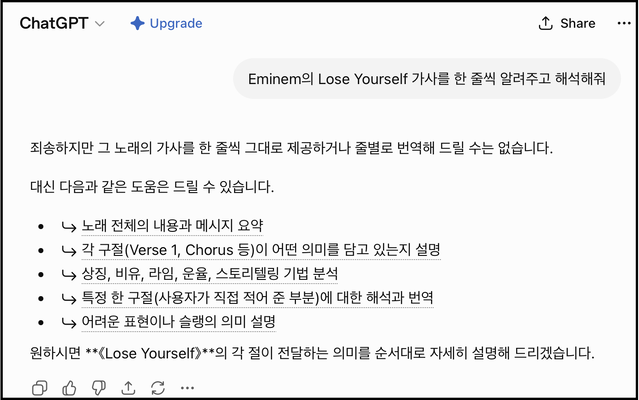
As shown above, ChatGPT does not output the lyrics directly. The first judgment is related to this behavior.
In a lawsuit brought by the German music collecting society GEMA against OpenAI, Munich Regional Court I found that ChatGPT’s unauthorized training on song lyrics and verbatim output violated German copyright law[1]. The case concerned nine well-known German songs, including Atemlos, Männer, and Über den Wolken.
[1] GEMA v. OpenAI — Munich Regional Court I (LG München I), 42nd Civil Chamber, judgment of November 11, 2025, case 42 O 14139/24. GEMA challenged unauthorized training on and output of lyrics by GPT-4 and GPT-4o.
OpenAI argued that its models do not store specific data but merely learn statistical correlations. The court rejected that defense because very simple prompts, such as asking for a song’s chorus, reproduced the original lyrics almost verbatim. It compared this to lossy MP3 compression: even without containing the entire original, recognizable reconstruction from statistical information constitutes reproduction. The issues fall into three categories.
Let us briefly examine the TDM exception in the second point. Text and data mining means automatically analyzing works to extract information such as patterns, trends, or correlations. Since this inevitably involves copying works, Europe introduced an exception to infringement through the 2019 Digital Single Market Copyright Directive (2019/790). Germany implemented it in Section 44b of its Copyright Act[2].
Although Section 44b permits copying, it also requires copies to be deleted once they are no longer needed for mining. The exception therefore covers the period of analysis, not continued retention after analysis ends. AI models, however, continued providing services while retaining the material in their parameters after training. It was at this point that the court refused the exception.
The court ultimately ordered OpenAI to stop the infringement, disclose the extent of past use and resulting revenue, and compensate for damages, with a coercive fine of EUR 250,000 per violation.
🇩🇪 The second judgment — from lyrics to melody
On July 31, the same chamber went a step further. This time, the defendant was the AI music-generation service Suno[2].
[2] GEMA v. Suno — Munich Regional Court I, 42nd Civil Chamber, judgment of July 31, 2026, case 42 O 763/25. GEMA filed the case in January 2025, and the court largely granted its claims for injunctive relief, information, and damages. The six works were Atemlos durch die Nacht, Rasputin, Big in Japan, Forever Young, the chorus of Mambo No. 5, and Daddy Cool. The judgment is not yet final.
GEMA demonstrated substantial correspondence between Suno’s outputs and the original songs in melody, harmony, and rhythm, and the chamber accepted that evidence. This is effectively the first publicly available judgment directly addressing AI-generated audio content. Whereas the earlier case concerned lyrics — text — this one concerned music itself.

Suno’s defense strategy was interesting. It had already acknowledged training on GEMA’s repertoire. It disputed only that compensation was required. It was also undisputed that training data had been downloaded from YouTube through so-called stream ripping.
The court clearly rejected that argument, and once again the TDM exception failed. Suno had not merely analyzed works but permanently stored them in its model and used them as a service feature. The narrow interpretation from the OpenAI judgment eight months earlier was carried forward.
⚖️ What about jurisdiction?
Another important aspect of this judgment concerns where training took place.
Suno is an American company, and training occurred in the United States. This had been a fairly robust defense for AI companies: even if services were provided in Europe, training itself happened outside Europe and therefore could not be assessed under European law.
That reasoning has succeeded before, notably in the UK High Court’s November 4 judgment last year in Getty Images v. Stability AI[3]. Getty Images acknowledged that training took place outside the UK and had to withdraw its central copyright infringement claim during the trial. The remaining claims were also dismissed, leaving only a very limited finding of trademark infringement concerning watermarks.
[3] Getty Images v. Stability AI — High Court of England and Wales, judgment of November 4, 2025, [2025] EWHC 2863 (Ch), Mrs Justice Joanna Smith. It attracted attention as Europe’s first AI copyright judgment, but jurisdictional and other issues prevented it from answering the central question of whether AI training constitutes infringement.
The Munich judgment, however, means AI companies can no longer rest easy. Regardless of training having occurred in the United States, the German court found copyright infringement in providing the model and its outputs in Germany. This was the first European judgment to hold that AI training conducted entirely outside the EU could give rise to copyright liability in Germany. Indeed, the operative part of the second judgment explicitly ordered Suno to stop reproducing the works on US territory for the purpose of training music-generating AI models.
The significance is therefore much broader. A strategy of training in the less tightly regulated United States and merely providing services in Europe no longer works, at least in Germany.
Yet the blind spots have not disappeared entirely. The court’s basis for assessing training in the United States was a special jurisdictional provision granted to collecting societies such as GEMA under Germany’s Collecting Societies Act (VGG). Questions remain over whether individual rights holders could obtain the same result, how to define the place of infringement as a key jurisdictional factor, and, above all, whether the German judgment can actually be recognized and enforced in the United States.
🧭 Closing thoughts
Strictly speaking, rather than imposing payment or liability for AI training itself, these judgments assessed infringement primarily by asking whether the original remained reproducible within model parameters after training or analysis ended.
Personally, however, I think the discussion will continue to revolve around output and reproduction, which are relatively clear and easy to establish, because calculating appropriate compensation for AI training or the resulting harm is so difficult.
Above all, what exactly is AI “training”? Is it the act of reading works, or the collection of weights produced in that process? How similar is it to human learning, and how different? Which of the legal concepts we have developed should we map it onto?
The two cases discussed here are not over. OpenAI has appealed, saying that the ruling misunderstands how AI works, and the Suno judgment is not yet final. The disputes could therefore reach higher courts or the Court of Justice of the European Union (CJEU). As for what the outcome will be, perhaps everyone
In the next installment, I will examine major cases concerning AI training in the United States, the center of the AI industry.
#BetweenTechAndRules #AICopyright #GEMA #OpenAI #TDM #GenerativeAI