
The third topic in “The World Through Patents” is cancer treatment.
Cancer remains one of humanity's greatest unsolved challenges. Yet retracing the past 50 years through patents reveals that the nature of this battle has changed markedly over the last decade.
In this article, I examine those changes using two reports on innovation in cancer technologies published by the European Patent Office (EPO) in 2024 and 2025: “Patents and innovation against cancer” and “New Frontiers in Oncology.” The reports organize 28 cancer-related technology fields by growth and maturity, making it easy to see which are advancing fastest.
📈 A turning point — what happened in 2015?
The first thing that stands out is a clear turning point around 2015.
The compound annual growth rate (CAGR) of cancer-related international patent families (IPFs) was just 1.7% from 2010 to 2015, effectively stagnating. It then rebounded sharply to 9.3% between 2015 and 2021, three times the average for all technologies over the same period (3.0%). Filing volumes also rose by 70% between 2015 and 2021.
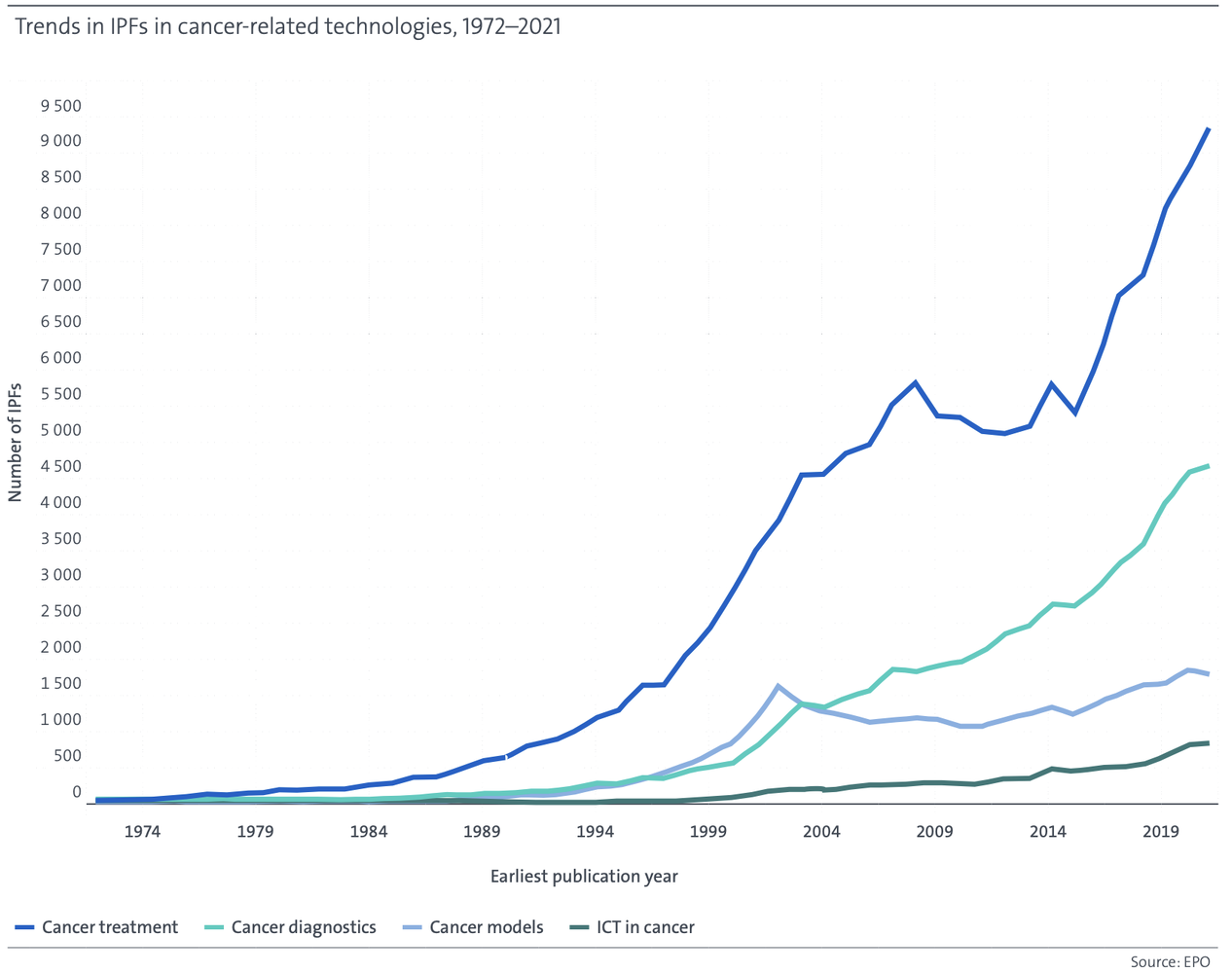
What happened in 2015? This was when clinical successes in cancer immunotherapy were being reported in succession and the cost of next-generation sequencing (NGS) was falling sharply, making data-driven precision medicine a reality. The patent surge can be seen as a signal that companies, having confirmed the potential for commercialization, were entering the IP race in earnest, rather than simply an increase in research activity.
For context, more than 140,000 cancer-related inventions have been published since 1970. In 2021 alone, over 13,000 IPFs were filed, accounting for 3% of global patent activity that year. This accumulation has also led to tangible results. Advances in diagnosis and treatment are estimated to have reduced cancer mortality in the EU by 12% between 1988 and 2022, saving more than five million lives.
🧬 The landscape — where biotechnology meets digital technology
The reports selected 28 high-growth areas within cancer technology and compared their growth rates and maturity. The chart below provides an overview.
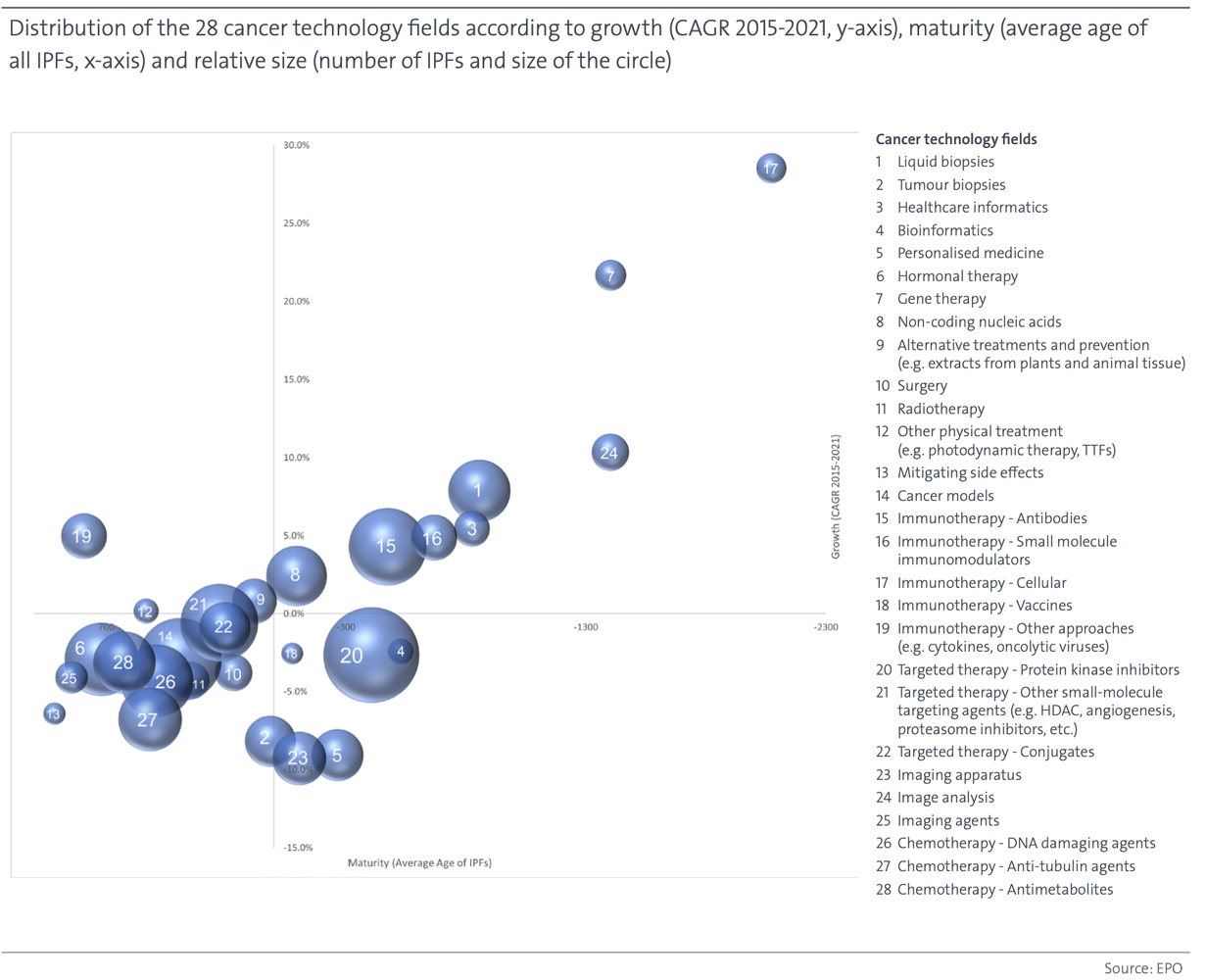
Grouping these high-growth fields by their characteristics produces two categories:
One group deals with data; the other with cells and genes. Although they seem entirely different at first, they have reportedly been converging in recent years. This is because research into AI-driven biomarker discovery has intensified. An approach is emerging in which data first identifies which treatment is likely to work for which patient, followed by cell or gene therapy for the selected patients.
🚀 Fields worth particular attention
Several fields stand out even among these high-growth areas.
First are cellular immunotherapy, exemplified by CAR-T, and gene therapy, both leading examples of next-generation biological therapies. Their technological histories are short, so their IPFs have a low average age. Startups and university hospitals, rather than large pharmaceutical companies, led early innovation in these areas. High treatment prices and complex manufacturing present clear barriers to commercialization, but the prospect of one-time treatments without repeated dosing is attracting investors and regulators alike. Securing IP positions now appears likely to help shape the treatment market over the next 10–20 years.
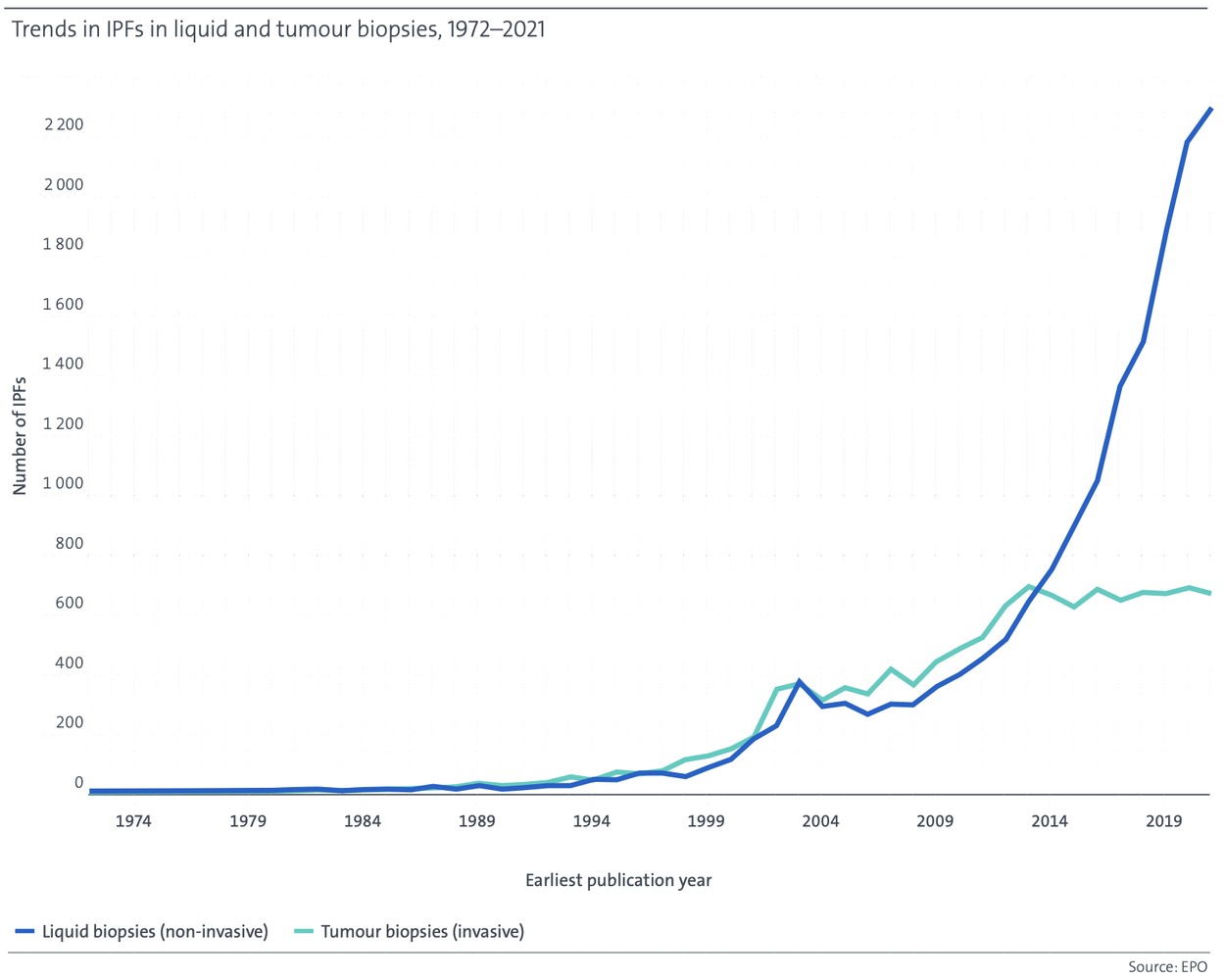
Next are liquid biopsies and AI image analysis within digital and data-driven technologies. Liquid biopsies analyze circulating tumor DNA (ctDNA) in blood to diagnose cancer early or monitor treatment response without tissue biopsies. Though still immature, this is one of the fields with the steepest filing growth. AI image analysis automates the reading of pathology slides and medical images, improving both diagnostic accuracy and speed. Big tech companies and medical startups are entering competitively. Both technologies face lower regulatory barriers than therapeutics and are therefore expected to commercialize more rapidly.
🌍 A question of “translation,” not just research
There is another part of these reports that gives me the most to think about: with comparable research achievements, some countries capture global markets while others stall at the startup stage.
The United States has the least friction between research and commercialization. The share of cancer-related IPFs contributed by US research institutions fell slightly, from 44.7% in 2016–2018 to 40.2% in 2019–2021. This was not because research institutions went backward, but because companies expanded their portfolios faster. The technology-transfer system developed since the Bayh–Dole Act and a deep venture-capital ecosystem provide infrastructure that rapidly converts publicly funded research into private-sector IP.
China follows a model in which the state creates the playing field and companies fill it with patents. The share attributable to Chinese research institutions fell sharply from 38.9% in 2010–2012 to 25.6% in 2019–2021, again indicating the rapid rise of private companies. This reflects the combination of large-scale biotechnology investment linked to national five-year plans and business-friendly patent incentives. China's gain in share is particularly striking in image analysis, at 12.6 percentage points.
Europe is strong in research but weak in translating it into business. Nearly half of EU cancer-related patent applications come from universities, public research institutions, and hospitals. Public research capabilities therefore remain among the best. Yet its share has declined in the high-growth fields.
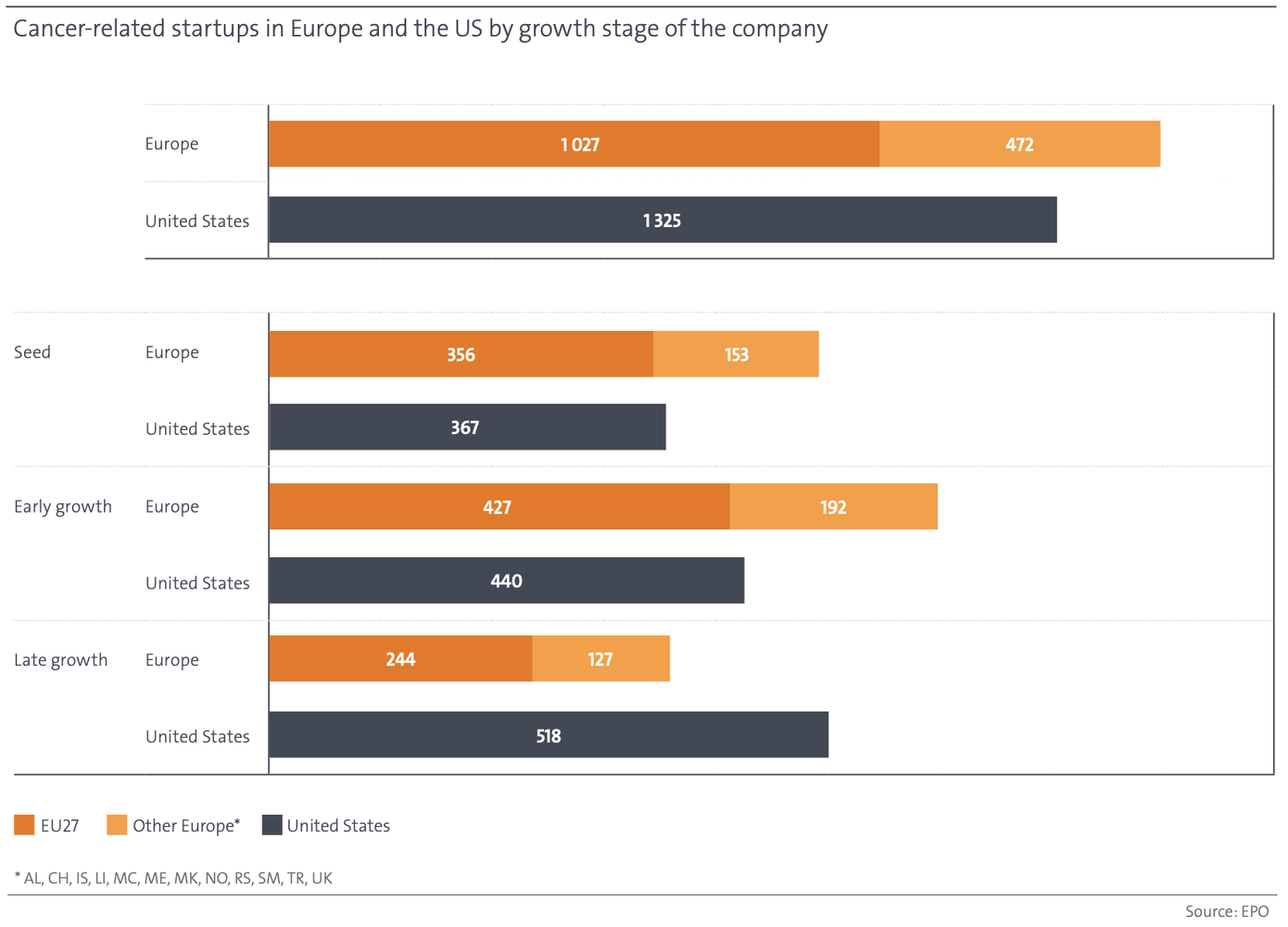
The chart above shows the following:
In other words, Europe has the world's largest number of startups but one of the lowest scale-up rates. The phenomenon known as the “European paradox*” is being repeated in cancer technology.
*The diagnosis that Europe leads the world in basic science but fails to turn its achievements into commercial success.
🧭 Closing thoughts
The picture is this: the United States appears to lead less because its researchers are better than because it offers the easiest environment for research results to be packaged as patents, patents to serve as investment signals, and investment to lead to commercialization. China is rapidly building that pathway through state determination, while Europe's resources are being exhausted somewhere along it.
Yet this “European paradox” does not sound like someone else's problem. The question of why world-class research does not produce global companies is very familiar to us as well.
One further thought: with technological maturity still low and filing competition not yet entrenched, the present moment may be the narrowest remaining window for latecomers to secure an early position. Whoever first produces an answer to the long-standing challenge of cancer will be welcome. Where the IP that creates that answer is accumulating, however, is a somewhat different question.
#BetweenTechAndRules #PatentTrends #CancerTreatment #LiquidBiopsy #CellTherapy #IPStrategy #EPO