
The first technology topic in “The world through patents” is quantum technology.
Quantum technology is often considered a technology of a future that has yet to arrive. Patent data tells a somewhat different story. Competition in quantum technology has already moved beyond laboratory discussions into an IP race aimed at global markets.
Drawing on Mapping the global quantum ecosystem, published jointly by the OECD and the European Patent Office (EPO) last December, I have organized this competition into three dimensions.
⚡ Speed — a race already under way
First, the pace of growth in patent applications is extraordinary.
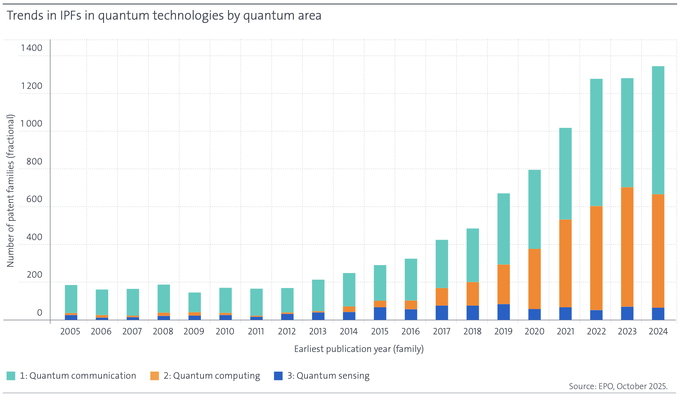
International patent families (IPFs) in quantum technology increased roughly sevenfold between 2005 and 2024 and have grown by approximately 20% annually since 2014. That is ten times the average rate across all technologies, around 2%, and goes well beyond what could be dismissed as a research boom.
Multi-country filings, submitted in several jurisdictions simultaneously, are growing particularly rapidly. This signals that quantum technology competition is already premised on securing an early position in global markets.
🔀 Direction — different strategies in communication, computing, and sensing
Even within quantum technology, IP strategies vary by subfield. The report broadly classifies quantum technology into communication, computing, and sensing.
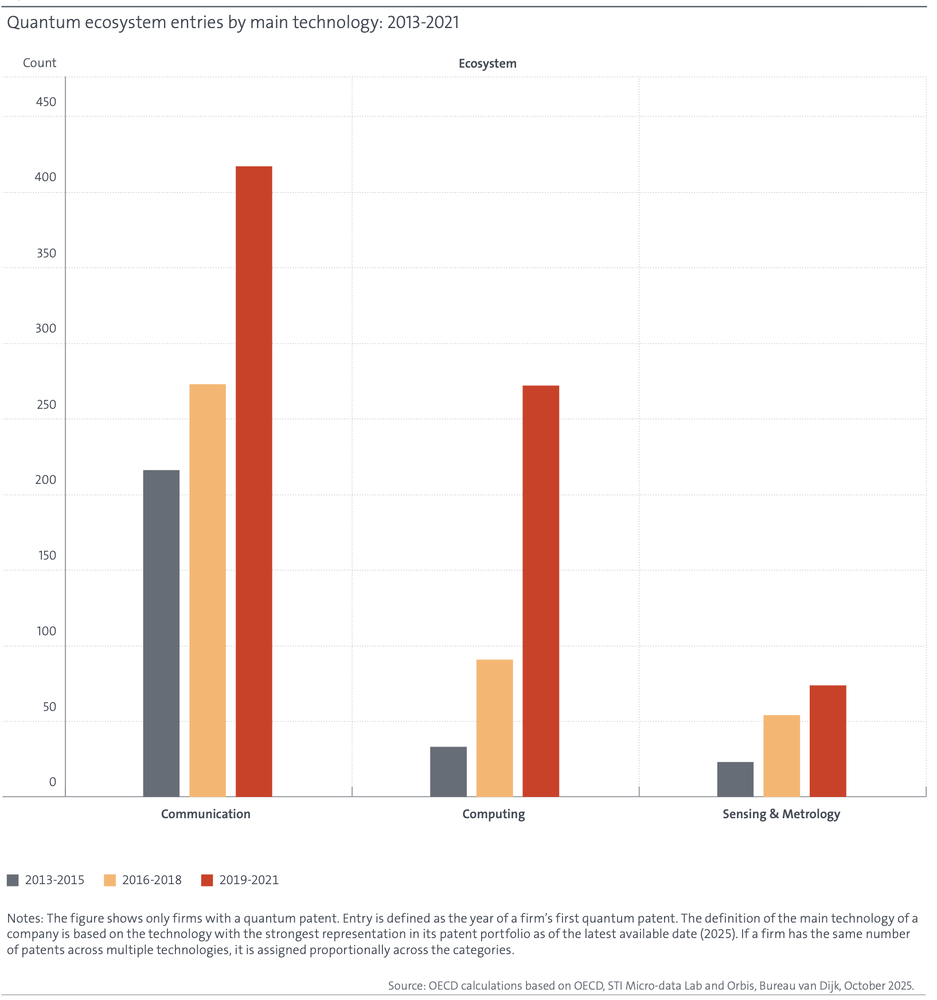
The characteristics of patent portfolios in each subfield can be analyzed as follows.
Quantum communication: cumulative portfolios built with long-term infrastructure and standards in mind. Because network effects and interoperability matter, continuity in the scope of rights is more important than any single invention.
Quantum computing: the field with the steepest recent growth. Since the technological path is not yet settled, early-positioning and exploratory filings are concentrated across hardware, software, and algorithms. Patents function less as defensive tools than as a way to secure future options in advance.
Quantum sensing: applications in existing industries such as measurement, medicine, and aerospace are central, so most filings are closely tied to specific applications rather than general-purpose platforms.
🏢 Participants — startups < established industry players
The report examined approximately 5,000 startups, companies, universities, and public research organizations (PROs) worldwide. Its findings can be summarized as follows:
The five leading quantum IPF applicants for 2005–2024 are IBM, LG, Toshiba, Intel, and Microsoft — all established large companies. It is easy to imagine quantum technology as a startup arena, but the data shows the opposite.
Why has this structure emerged? Quantum technology has yet to generate substantial revenue, so participants need the resources to withstand long research periods. The report also notes that many specialist startups rely on external funding. Actual trends bear this out. New business formation grew rapidly until 2021 but has recently shown signs of stagnation. Investment likewise declined in 2022–2023 after peaking in 2021, before partially recovering in 2024. Investment per deal has also become smaller.
It is also striking that the field remains closer to science than to technology. More than half of quantum startup founders hold doctorates, a stark contrast with roughly 10% among founders generally. The workforce is likewise concentrated in technical and research roles.
In the overall picture, startups handle experimentation and connection-building, but the results ultimately accumulate in established industry portfolios. This is also why the report considers large incumbent companies to be best positioned to lead commercialization once the technology matures.
🇰🇷 South Korea’s position
Where, then, does South Korea stand in this intense quantum technology race?
In IPF filings by country, South Korea is certainly in the leading group. The report identifies Japan as the second-largest filing country, followed by China and South Korea.
The company-level picture is even more impressive. LG ranks second worldwide among quantum IPF applicants for 2005–2024, immediately behind IBM and ahead of Toshiba, Intel, and Microsoft. A Korean company is thus among the very top global players.
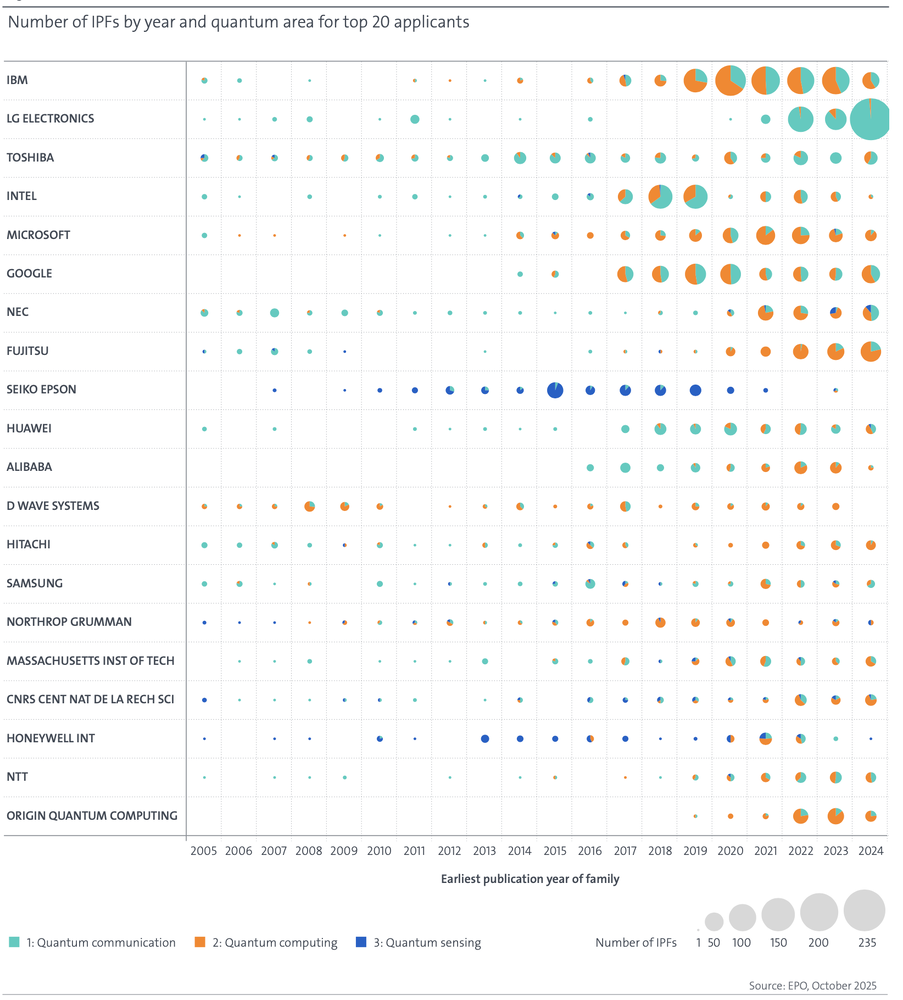
By subfield, South Korea has a clear presence in quantum communication. The report specifically highlights the country in this area. That seems a natural outcome given its strong existing communication, semiconductor, and network industries. Conversely, in quantum computing, where the race for early positioning is most intense, its concentration is lower than that of specialized countries such as Canada, the United Kingdom, and the United States.
The global pattern described earlier is even more pronounced in South Korea when we look at participants. Large companies and research institutions accumulate IP, rather than pure quantum startups. For context, separate statistics counting pure-play quantum companies show the United States far ahead with 164, followed by Canada with 59, the United Kingdom with 56, Germany with 48, and France with 29. South Korea does not appear among the leaders on that list.
🧭 Closing thoughts
Interestingly, the report diagnoses the quantum sector as moving beyond explosive growth into a more focused and mature development phase. If so, the contest ahead will shift from who filed first and how much to who can turn those rights into actual commercialization.
From that perspective, South Korea’s achievement in joining the leading filing countries alongside nations with vast capital and large markets is considerable. It may not be an explosive front-runner, but accumulating IP on an industrial foundation centered on communication represents a strategy of its own. The remaining question is how to expand that accumulation and translate it into commercialization.
“The world through patents” will continue to return at irregular intervals with a variety of technology topics.
#BetweenTechAndRules #QuantumTechnology #PatentTrends #QuantumComputing #IPStrategy #EPO