
When people discuss semiconductors, most think of manufacturing processes and capital expenditure. Yet one company has no factories and makes no finished products: the British semiconductor design business ARM (Arm Holdings).
ARM dominates its market through intangible assets alone. That dominance comes not from one extraordinary patent but from the design of its licenses. In this article, I will examine ARM’s licensing strategy in detail.
🏭 A company without factories, outstanding results
ARM began in November 1990 as a joint venture between Acorn Computers, Apple, and VLSI Technology. Twelve engineers started the company in a former turkey barn near Cambridge. A decision made by Robin Saxby, who became its first CEO the following year, is widely credited with shaping today’s ARM. Instead of manufacturing chips itself, it licensed processor designs to other companies in exchange for upfront license fees and sales royalties. This was an unusual business model at the time.
These processor designs reached the mobile-phone market through Texas Instruments and the Nokia 6110 in 1997, later becoming the standard in the smartphone era. According to ARM’s listing disclosures, 99% of mobile application processors were ARM-based at the end of 2022, and cumulative shipments have exceeded 350 billion chips.
Results for the fiscal year ended March 2026 were as follows:
With no factories or inventory, increased revenue feeds directly into profit. What kind of licensing design makes this remarkable structure possible?
🧩 One technology, three licensing routes
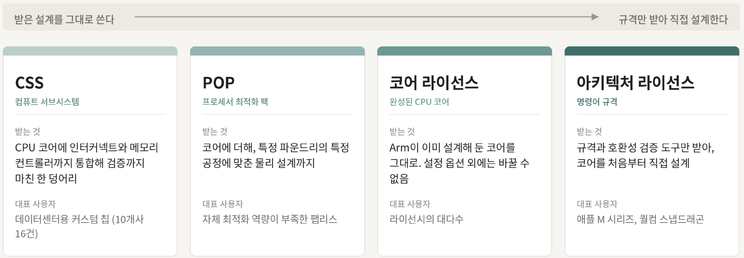
A core license allows companies to use CPU cores already designed by ARM, such as Cortex and Neoverse, as supplied. Apart from a few configuration options, the core itself cannot be altered, but development time and risk fall sharply. Most licensees enter through this door.
An architecture license provides instruction-set specifications and compatibility-validation tools rather than a finished core, allowing companies to design their own cores from scratch. Apple’s M series and Qualcomm’s highest-end Snapdragon products fall into this category. Costs and difficulty are much greater, but companies can create cores optimized for their products. The resulting design must nevertheless pass ARM’s compatibility tests. Implementation belongs to each company, but it must remain within the specification.
POP (Processor Optimization Pack) also supplies physical designs optimized for a particular process at a particular foundry. Even companies without the expertise to refine a core themselves can achieve validated performance, bridging the gap between design and manufacturing.
More recently, CSS (Compute Subsystem) has been added: a package in which a CPU core and surrounding IP, such as interconnects and memory controllers, are integrated and validated in advance. By mid-2025, ten companies had reportedly signed 16 CSS licenses.
What strikes me most about this structure is that whichever layer customers choose, they ultimately enter the same architectural ecosystem. Even a company like Apple, which designs an entirely new core, uses ARM’s instruction-set specification and has compatibility confirmed through ARM’s tests. Customers enjoy extensive technical freedom, while ARM retains control over the architecture’s direction of evolution.
It is a design that opens multiple doors to bring in more companies, rather than excluding competitors.
📈 A structure in which prices rise with each generation
ARM has two revenue streams: upfront license fees paid at contract signing and royalties collected whenever a chip incorporating its design is sold.
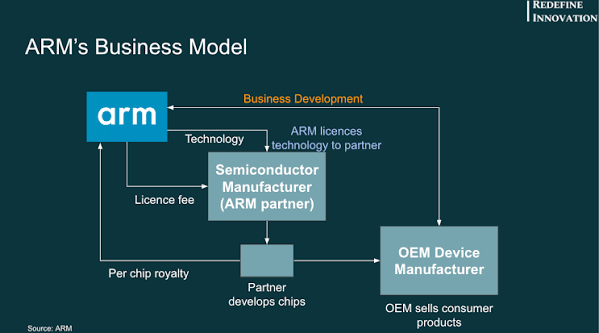
Upfront fees vary widely by license type. Architecture licenses are reportedly priced between $1 million and $10 million.
The royalty rate is particularly interesting. ARM has publicly stated that the current v9 architecture carries roughly twice the royalty rate of the previous v8 generation, while CSS carries an even higher rate. For context, calculating backward from its listing disclosures, ARM received about $1.78 billion in royalties on approximately $98.9 billion of chips incorporating its technology in 2022, giving an overall average of 1.7–1.8% of chip prices. The structure raises this average as generations advance.
In other words, ARM’s revenue rises simply when customers switch to newer architectures, even without selling more chips. Recent royalty growth has indeed been driven by increased adoption of v9 and CSS, rather than greater shipment volume.
Another feature is the time structure. According to ARM’s listing disclosures, roughly 46% of royalties for the fiscal year ended March 2023 came from products launched between 1990 and 2012. Nearly half of current royalties therefore come from designs more than a decade old.
Once established, intangible assets generate returns for a very long time. This shows how different the timeline of an intangible-assets business is from that of manufacturing.
🇰🇷 South Korea’s position
South Korea is mainly on the user side of the processor design industry.
Most processors designed domestically, including Samsung Electronics’ Exynos, use ARM licenses. Korean fabless companies also account for less than 1% of the global market, and many are small businesses with annual revenue below KRW 10 billion, so IP licensing costs themselves have acted as an entry barrier. This was the background to the Ministry of Trade, Industry and Energy’s programs through the System Semiconductor Design Support Center since 2021, including discounts on global IP, ARM technology consulting, and support for domestic IP costs.

There are signs of progress. OPENEDGES Technology, established in 2017, supplies memory-subsystem and NPU IP through licensing and royalties while expanding its overseas customer base. It is a rare Korean example of a company that has reached a public listing using this model.
Its scale is not yet comparable, but I think it is significant that a move has begun from buying and using IP to selling IP and receiving royalties.
🧭 Closing thoughts
There is one further development to mention. In 2026, ARM introduced its own silicon chip for the first time in its 35-year history: a CPU for AI data centers. A company that had sold only designs entered the finished-product market. If a business that licenses IP starts making chips itself, it becomes a potential competitor to its existing licensees. Whether the trust built through broad adoption can withstand this transition should be one of the most interesting developments to watch over the next few years.
The lesson of ARM is that managing intangible assets is about more than managing patents well. Patents remain important, but ARM’s real competitive strength lay in the design beyond the patents. Managed only as legal rights, patents become a cost; managed as standards and an ecosystem, they become industrial infrastructure. Future company value will depend not on how many intangible assets a business holds but on whether those assets have been structured to occupy an indispensable position in the industry.
#BetweenTechAndRules #ARM #IntangibleAssetManagement #IPStrategy #LicenseManagement #RISCV #Semiconductors