

The past four articles all discussed artificial intelligence. This time, let us turn to a different subject.
In November 2025, provocative advertisements appeared in the New York subway. Smiling babies covered the posters alongside “Have Your Best Baby” and “Height is 80% genetic, IQ is 50% genetic.” The linked address was pickyourbaby.com. Behind this striking campaign was the American genetics startup Nucleus Genomics.
I found it intriguing and disconcerting. Even in the capitalist United States, was this really possible? It raised numerous ethical, legal, and technological questions, so I decided to investigate.
🧬 What is the service?
Nucleus Embryo, introduced by Nucleus Genomics in June 2025, claims to analyze DNA from embryos created through in vitro fertilization (IVF) and score around 2,000 traits. These include risks of cancer, heart disease, and Alzheimer’s, as well as height, IQ, predicted lifespan, body mass, hair loss, and eye and hair color.
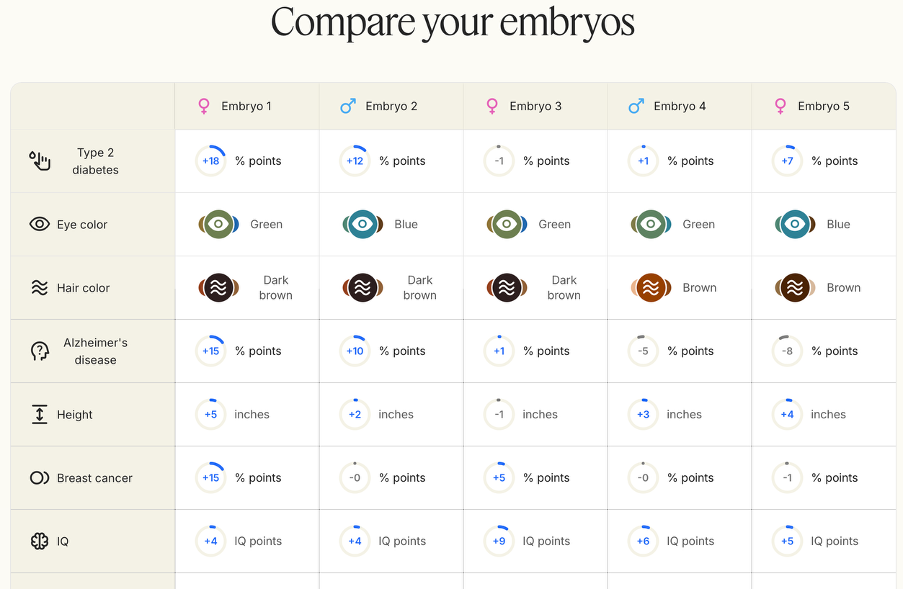
Parents compare embryos side by side using these scores, choose the “best” one, and proceed with pregnancy. The price is approximately $5,999. A preview feature also uses only the couple’s DNA to project hundreds of traits their future child might inherit.
The core technology is the polygenic risk score (PRS). Rather than examining a single gene, it combines tens of thousands of small genetic variations to predict traits probabilistically. The company calls this genetic optimization. Founder Kian Sadeghi promotes it as allowing embryos to be optimized for intelligence for the first time in history. The service has already expanded beyond the United States to Mexico, and in 2026 to clinics in India and the Middle East.
🔬 Is it scientifically possible?
The first question is how far current science and technology can actually predict traits.
The advertising is confident, but scientific assessments are negative. Professional organizations, including the American College of Medical Genetics and Genomics, have warned that embryo polygenic scores have advanced too far on too little evidence. The technology is not recognized as standard care anywhere in the world. Major IVF clinics still refuse to offer these tests.
The reason is clear. Polygenic scores may work to some extent across broad populations, but their predictive power falls sharply among sibling embryos from the same parents. Selecting for height could also inadvertently select for other, unknown risks. This is why geneticists invoke neo-eugenics, Gattaca, and even Theranos[1].
[1] Theranos Inc., founded by Elizabeth Holmes, attracted enormous investment by claiming it could diagnose hundreds of diseases from a few drops of blood. Those claims were false. Investigative reporting by The Wall Street Journal exposed the reality in 2015; the company was liquidated, and the affair became a notorious biotechnology investment fraud.
The company, of course, counters that it is simply providing information to give children the best possible start, not practicing eugenics.
That judgment remains open. At least scientifically and technologically, however, Nucleus Genomics appears not to have reached the level promised by its advertising.
⚖️ Is it legally possible?
Even without invoking eugenics, technologies involving embryos provoke a kind of instinctive unease. Dystopian science fiction reinforces that discomfort.
Although on a different level, one earlier experiment involving embryo genes shocked not only science but the world. In 2018, Dr. He Jiankui of China’s Southern University of Science and Technology claimed to have used CRISPR gene editing on human embryos for the first time, resulting in the birth of twin babies allegedly resistant to HIV(!). Because this involved germline editing that could be inherited by descendants, it drew intense condemnation. He was sentenced to three years in prison for illegal medical practice.

Let us assume traits can be predicted genetically. Would there still be no regulation of such services?
In the United States, regulation of embryos centers on whether an activity constitutes medical practice: whether a doctor makes treatment decisions or directly intervenes in a patient’s health. Nucleus Genomics defines itself as a data and information service, not medicine. It emphasizes that it is not a medical institution, that no clinicians are involved, and that results are probabilistic statistical information rather than definitive diagnoses. Actual embryo testing is outsourced to other laboratories. This currently keeps it outside FDA and medical-law regulation.
Above all, the United States has no federal rules directly targeting polygenic embryo selection. There are therefore few restrictions on what is measured, scored, or supplied: effectively a laissez-faire situation.
The structure works as follows. Embryo testing of the PickYourBaby kind is classified as laboratory-developed testing (LDT). Traditionally, the FDA has left LDTs under enforcement discretion, while laboratories themselves are overseen by CMS under the Clinical Laboratory Improvement Amendments (CLIA). CLIA examines only whether a test measures what it claims to measure — analytical validity — not whether its predictions are medically meaningful — clinical validity. The FDA issued a rule in 2024 to regulate LDTs as medical devices, but faced industry opposition and litigation. Federal premarket review of such tests still does not take place.
Nucleus has therefore not cleverly evaded regulation so much as entered a space where regulation does not yet exist.
I investigated one further question. Sperm banks are well established in the United States. How exactly does PickYourBaby differ from choosing preferred sperm from a sperm bank?
The decisive differences between PickYourBaby and selecting a sperm donor can be grouped into two points.
First, sperm banks provide existing facts, such as a donor’s height, education, and family history. PickYourBaby sells predictions, assigning scores to a future that has not arrived. Law may be permissive toward factual information, but becomes much more sensitive when human futures are ranked.
Second, there is timing. Sperm selection chooses material before fertilization, before any life has formed. PickYourBaby compares embryos that already exist. This seems to be where an invisible boundary between choosing and selecting is thought to be crossed.
In either case, however, the same fact remains: someone is choosing conditions on behalf of a person who has not yet been born.
🇰🇷 What if it launched in South Korea?
Could PickYourBaby enter South Korea? To give the conclusion first, it could not.
Article 50 of the Bioethics and Safety Act permits genetic testing of embryos only to diagnose specified genetic diseases. It expressly prohibits tests concerning appearance or personality where scientific uncertainty could mislead people[2]. The American model of scoring and advertising height, intelligence, and appearance cannot cross this legal threshold.
[2] Bioethics and Safety Act, Article 50 (Restrictions on Genetic Testing, etc.). (1) A genetic testing institution shall not perform genetic tests concerning physical appearance or personality that may mislead subjects because scientific verification is uncertain, or other genetic tests prescribed by Presidential Decree following deliberation by the National Committee. (2) A genetic testing institution may conduct genetic tests on embryos or fetuses only for diagnosing muscular dystrophy or other genetic diseases prescribed by Presidential Decree.
🧭 Closing thoughts
PickYourBaby presents an appealing rationale: give your child the best possible start. But when parents receive a scorecard with numbers for intelligence and even predicted lifespan, might they begin to view their child as an outcome to be upgraded to better specifications? And if science cannot yet guarantee even those numbers, what exactly are we choosing, and on what basis?
Once again, technology has arrived ahead of law and social consensus. What remains is our agreement about how far it should be permitted. If you could, would you want to receive a scorecard listing your future child’s IQ and height in advance?
#BetweenTechAndRules #GeneticTesting #EmbryoSelection #Bioethics #PolygenicScores #PickYourBaby