
On October 6, 2026, a humanoid appeared at the National Assembly Science, ICT, Broadcasting and Communications Committee’s parliamentary audit.
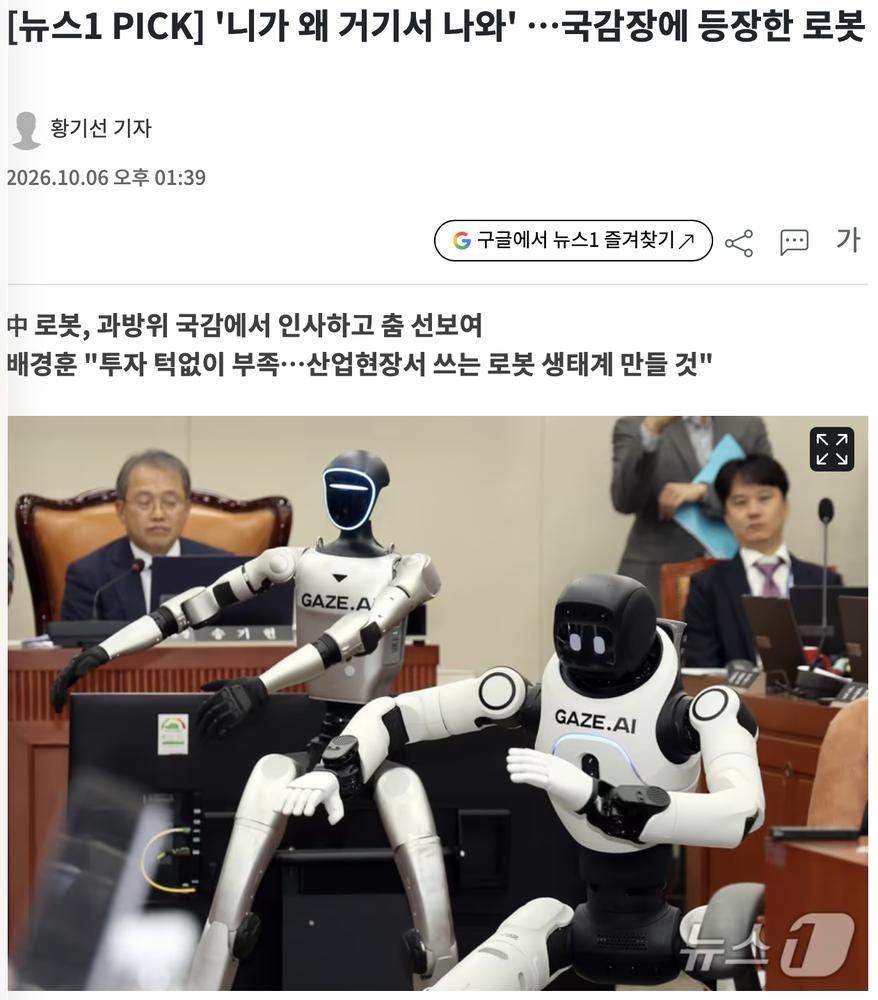
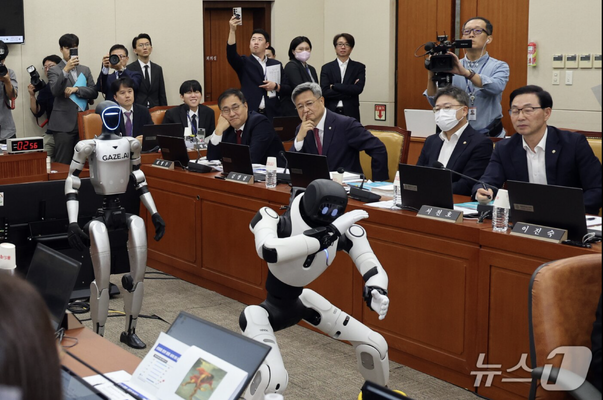
Assembly member Lee Jung-heon, who brought the robots, highlighted the rapid growth of China’s humanoid industry (the humanoids were Chinese products). After the demonstration, he pointed out the gap between the Chinese and Korean humanoid industries.
Yet we still rarely see humanoids around us. We occasionally encounter a robot serving food in a restaurant, but that is a long way from a humanoid.
In fact, very few humanoids have been sold so far. According to World Robotics 2026, released in September by the International Federation of Robotics (IFR), around 7,000 humanoids were sold worldwide in 2025. The IFR considers this market to be “at the threshold between laboratory and pilot deployment.”
Will the humanoid market continue to grow? It appears so. A market of just 7,000 robots already has 26,000 patents accumulated in it, counted by patent family.
The seventh topic in “The World Through Patents” is humanoid robots. Drawing on the report Humanoid Robotics: What Patent Data Reveals, published this July by patent analytics company LexisNexis IP, and the Ministry of Intellectual Property’s IP5 statistics, I have organized the picture into three points.
📈 7,000 robots, 26,000 patents
LexisNexis divides humanoid patents into three categories: Morphology, covering human-shaped bodies, bipedal walking and articulated limbs; Control & Planning, coordinating movement; and Interaction Systems, grasping and handling objects.
Of these, interaction and control-and-planning patents are not technologies exclusive to humanoids. Patents for industrial robots, logistics automation and surgical robots are included too. Patents in these two technology categories have risen steadily since the mid-2010s, reaching around 1,600 and 2,100 a year, respectively, in 2024.
By contrast, morphology patents concerning human-shaped bodies are a category specific to humanoids. They hovered between 500 and 700 a year from 2016 to 2022, then surged from 2023 and reached the same level as interaction patents in 2025.
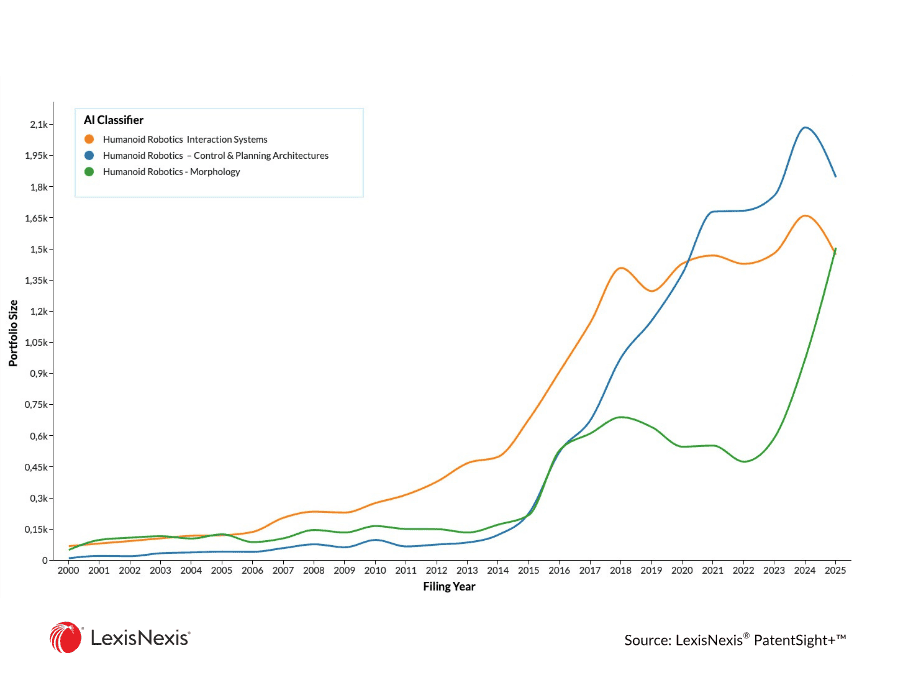
The year 2023, when morphology patents began to move, coincides with the wave of new companies identified by the IFR. The IFR noted that many of the 174 humanoid manufacturers were established in recent years, and that this founding wave coincided with breakthroughs in generative AI. AI models enabled robots to learn tasks by watching demonstrations and turn verbal instructions into actions. Progress became possible because an era had arrived in which, given a body, the brain could be borrowed.
🌏 China leads in volume, the United States in influence
To examine patent activity by country, LexisNexis classified patents by inventor location and plotted them by year. According to the chart, Chinese inventors accounted for 103 patent families in 2010, fewer than Japan’s 168 and on a par with Korea’s 104. Growth then accelerated: 579 in 2015 and 1,210 in 2016, doubling in just a year. China now accounts for more than half of worldwide patents.
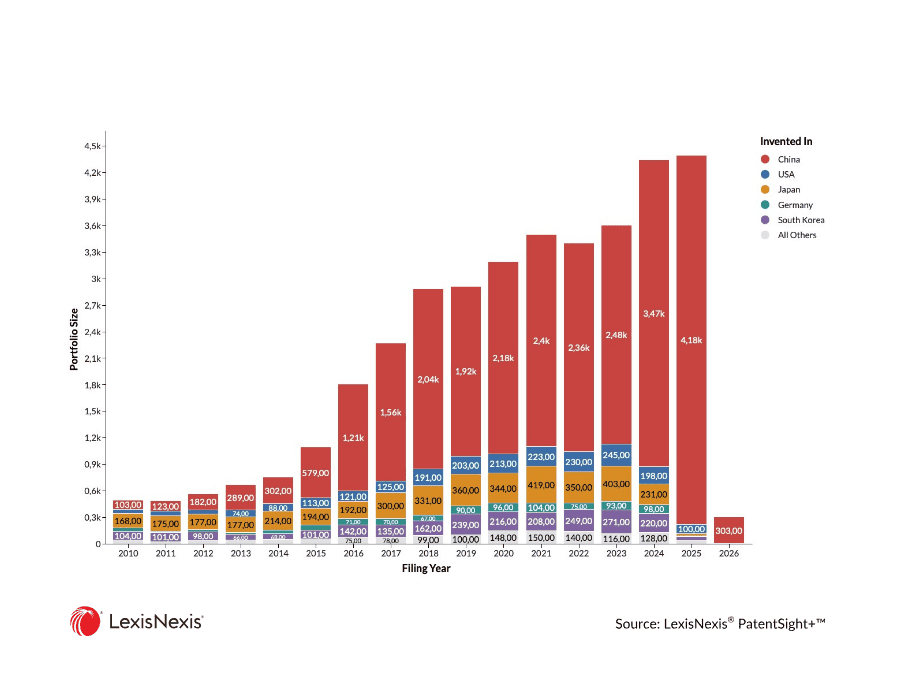
Comparing 2023, for which publication is complete (later years remain incomplete because of the 18-month publication delay), China had 2,480, Japan 403, Korea 271, the United States 245 and Germany 93. China alone had more than twice the combined total of the other four.
It is also striking that Korea has more than the United States. This has been the case almost every year since 2019.
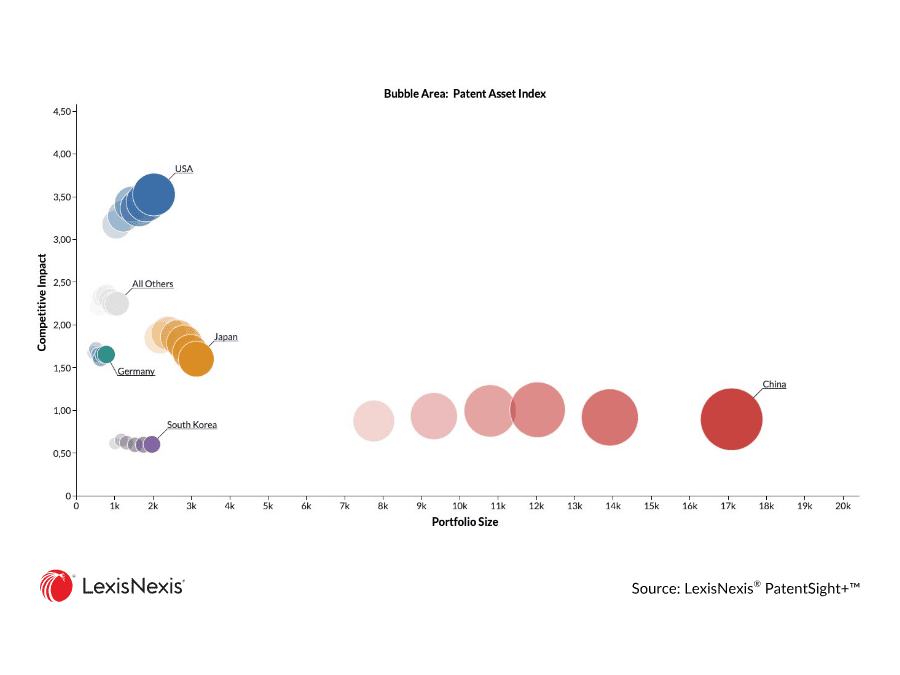
But patent counts are not all that matters. Their strength and influence matter too. Using a metric called the Patent Asset Index (PAI), LexisNexis assessed portfolio influence by combining how often individual patents are cited by subsequent inventions with the number of countries in which protection has been secured.
Looking at morphology patents through this metric changes the rankings. By number of active patents, China accounts for 73%, Korea 11%, Japan 7% and the United States 5%. By influence, the shares are China 63%, the United States 11%, Japan 10% and Korea 7%. The United States ranks fourth by volume but second by influence, and its average influence per patent is the highest among the three countries.
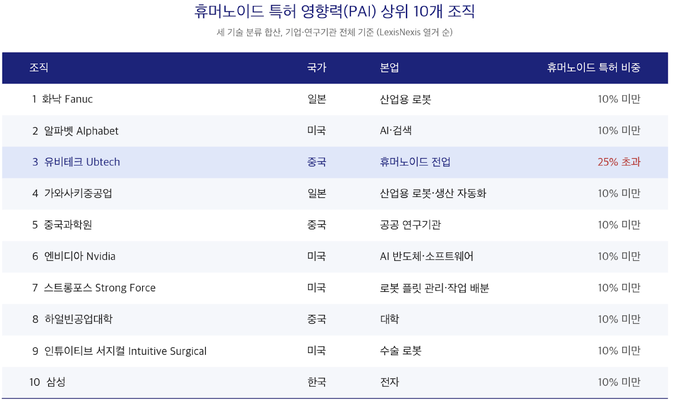
Which companies are filing humanoid patents? The ten most influential organizations identified by LexisNexis are Fanuc, Alphabet, Ubtech, Kawasaki Heavy Industries, the Chinese Academy of Sciences, Nvidia, Strong Force, Harbin Institute of Technology, Intuitive Surgical and Samsung.
Interestingly, for nine of them—all except Ubtech—humanoid patents make up less than 10% of their overall portfolios. Rather than specializing in humanoids, these are organizations working in industrial robotics, search, semiconductors or surgical robotics, with humanoids as a sideline.
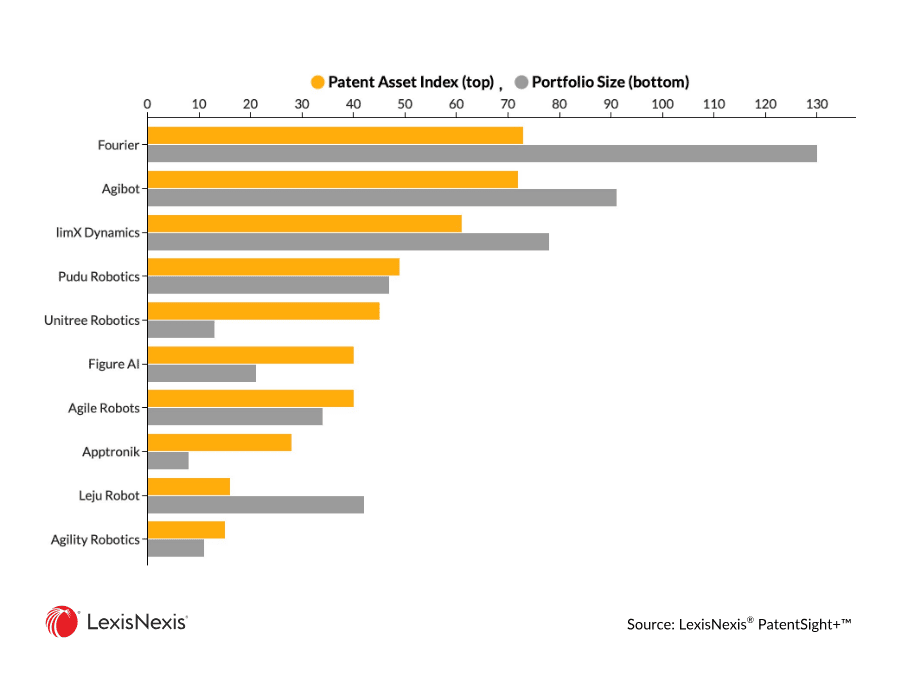
There are separate companies devoted exclusively to humanoids. LexisNexis’s top ten specialist humanoid startups include Fourier, Agibot, LimX, Pudu and Unitree, and six of the ten are Chinese. More than half of the 174 manufacturers counted by the IFR are also in China.
🧠 Why companies that do not make robots also rank in the top ten
The humanoid patent race is not limited to robot bodies themselves. Software, which serves as a robot’s “brain,” is also a core area of the humanoid and robotics industries.
At the heart of this “brain” category are Robot Foundation Models. These AI models convert camera input and verbal instructions into actions; Nvidia’s GR00T and Google DeepMind’s Gemini Robotics are leading examples. This explains why Alphabet and Nvidia, mentioned earlier, rank among the ten most influential organizations without selling robots.
In a report this April, the Korea Institute of Machinery and Materials describes global competition in the humanoid industry along five axes: AI and software intelligence, high-precision components, mass production and price, vertical integration, and HRI and field demonstrations.
The United States scores full marks in AI and software intelligence, while China scores full marks in mass production and price and in vertical integration. Korea scores 4 for high-precision components and vertical integration, but 3 for AI and software intelligence and 2 for field demonstrations.
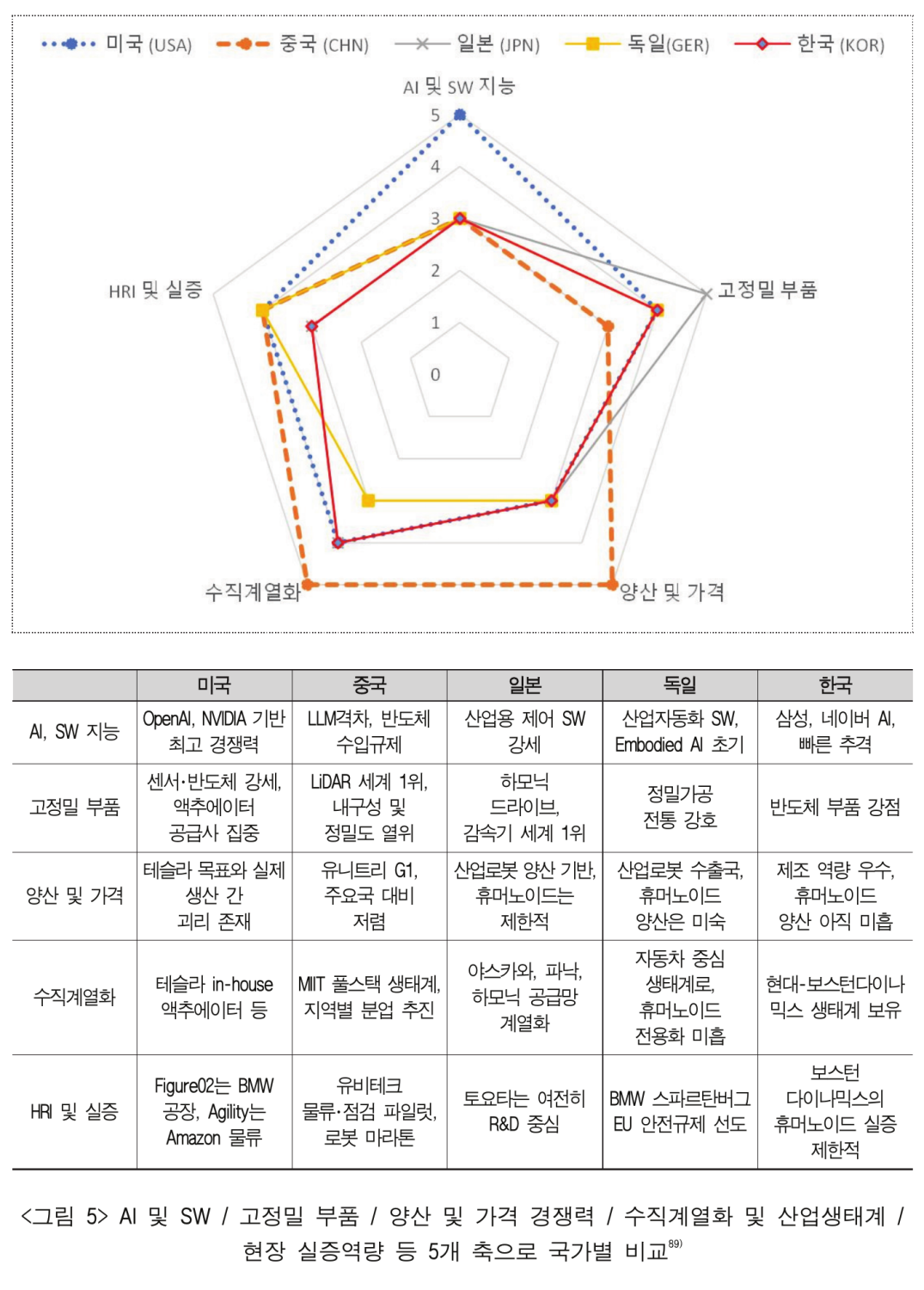
The report interprets this chart as follows: the United States controls humanoids’ brains through AI foundation models and semiconductors, while China controls bodies and prices through competition in mass production among more than 140 companies. Chinese companies accounted for 70% of new humanoid models introduced in 2025. Unitree launched the $5,900 R1 the year after introducing the $90,000 H1 in 2024. The report expects manufacturing costs, now around $35,000 per robot, to fall to between $13,000 and $17,000 within five years.
Patents for the brain show the same pattern. According to Ministry of Intellectual Property statistics, China accounted for 66.3% of Robot Foundation Model patents in the first half of 2026, the United States 14.1% and Korea 8.8%. The United States rises from 5% in morphology patents, corresponding to the body, to 14% in the brain.
The same report diagnosed Korea as having a hardware base in semiconductors, batteries and communications infrastructure, but weaknesses in foundational AI technology and the supply chain for humanoid-specific components. It then proposed a two-track approach: bringing key components such as actuators and controllers in-house, while partnering with big tech on foundation models to narrow the gap, with 2030 as the deadline.
🧭 Closing thoughts
Personally, I think Korea’s starting position is not bad. Not every country holds second place worldwide in a field. What is missing is technology for the brain and the transition that turns research institutes’ patents into companies’ products.
In a market where 7,000 robots have been sold, there are 26,000 patent families. As in other emerging fields, patents are being laid down before humanoids enter the market. This period of low technological maturity seems to be the narrow window still available for latecomers to secure an early position.
In two years, Unitree’s humanoid price has fallen from $90,000 to $5,900—from the price of a car to that of a few laptops. Goldman Sachs forecasts sales of 2.1 million units in 2035 alone. The scene of a robot shaking hands with an assembly member and dancing at the parliamentary audit may have looked like a show, but it could become everyday life much sooner than we think.
In the not-too-distant future, what will robots be doing beside us?
The “The World Through Patents” series will continue to appear from time to time.
#BetweenTechAndRules #TheWorldThroughPatents #Humanoids #Robots #PhysicalAI #Patents