
Jonathan Zittrain, who appeared in the previous instalment as the author of The Atlantic essay “The Internet Is Rotting,” is a professor at Harvard Law School. His research focuses on the relationship between the internet and law, and for more than a decade he has been investigating broken links on the web by counting them himself.
One particular incident prompted him to start this work.
On June 27, 2011, the US Supreme Court ruled that a California law prohibiting the sale of violent video games to minors was unconstitutional. Justice Samuel Alito agreed with the outcome but wrote a separate concurring opinion. Emphasising how extreme violence in modern games had become, he cited websites he had visited himself. One of them was ssnat.com.
When someone opened that address some time later, the original content had been replaced by this message:
“Aren’t you glad you didn’t cite this page in the United States Reports? If you had cited it, as Justice Alito did, the original content would have disappeared long ago and someone else would have bought the domain to make a point about the fleeting nature of links in the internet age.”
“And if you quoted this in The New York Times, would you publish a correction about the text that has now changed?”
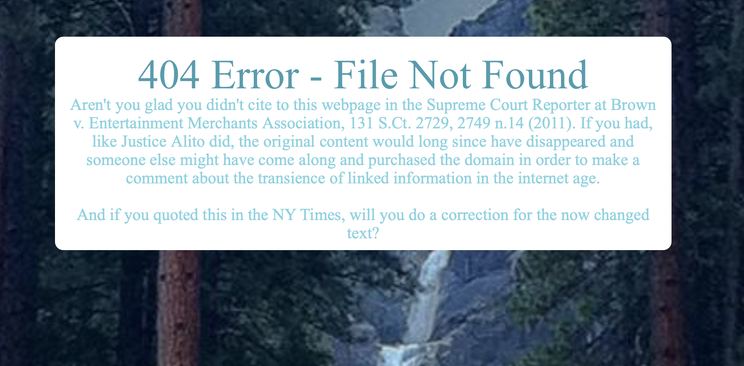
It was a prank left by someone who had bought the expired domain. A source underpinning a Supreme Court opinion—one of the documents written to last longest in the United States—had failed to survive even a few years.
Zittrain decided to investigate the problem further with colleagues Kendra Albert and Lawrence Lessig.
🔗 Citations that cannot be checked
The three researchers clicked every URL cited in Supreme Court opinions since hyperlinks first appeared in an opinion in 1996. Half no longer led to the content they had originally pointed to. This included both link rot, where clicking an address brings up nothing, and reference rot, where the address opens but the cited content has disappeared or changed.
Law is a system built on citations. Opinions support their conclusions by citing earlier decisions, statutes and other materials, and subsequent decisions cite those opinions in turn. With half of those sources reduced to addresses that could no longer be visited, the situation was quite serious.
The picture outside the courts is no different. Pew Research Center followed the links on 500,000 US government webpages, 500,000 news webpages and 50,000 English Wikipedia articles as of spring 2023. At least one link failed to open on 21% of government pages and 23% of news pages. Larger news outlets did not maintain their links any better.
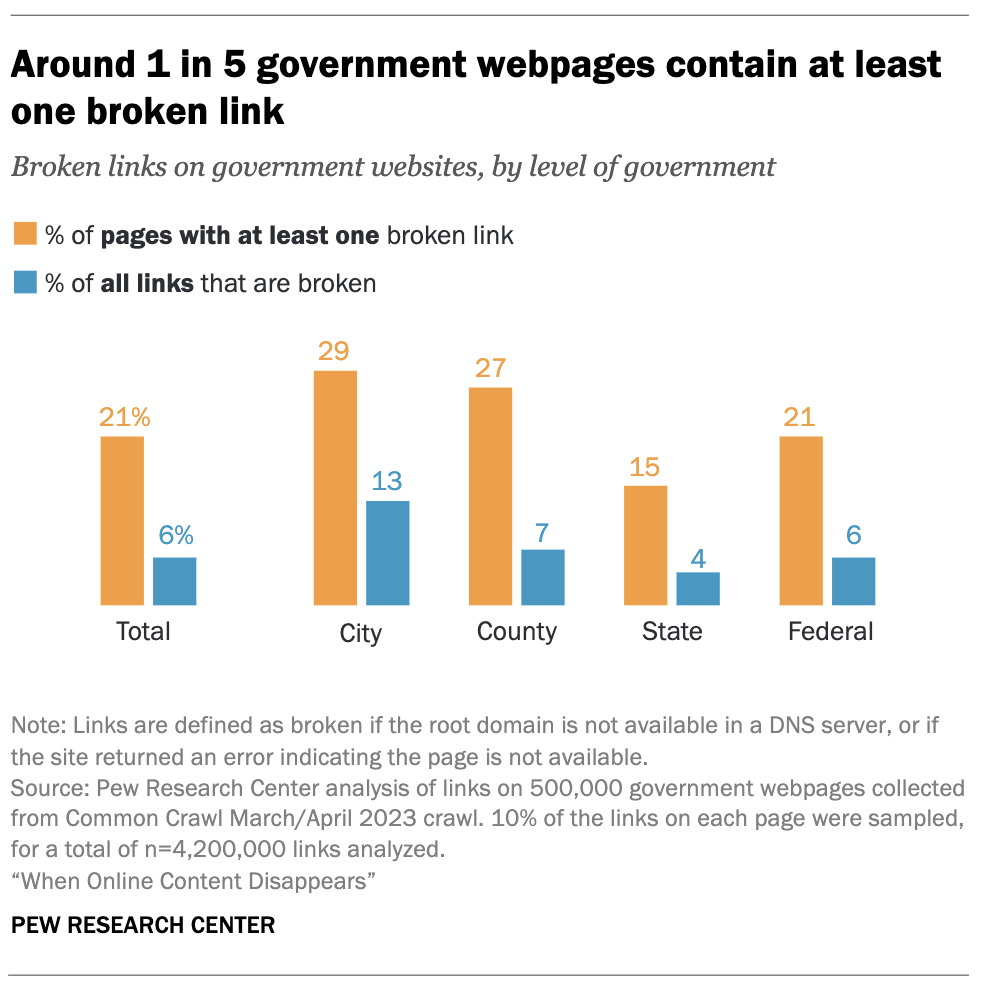
Wikipedia fared even worse. Eleven per cent of reference links were dead, and 54% of articles contained at least one dead reference link. In effect, half of the world’s most widely read encyclopedia relied on sources readers could not visit to verify.
🛟 The people who preserve
So far, the web seems to be collapsing beyond repair. But do you remember how, at the end of the previous instalment, we saw that quite a few inaccessible pages had not really disappeared? That was because someone had stored copies somewhere on the web.
Who was doing this? It was neither a government, nor a university, nor a company that had built the web. It was a single nonprofit organisation established by one person: the Internet Archive, the nonprofit digital library founded by Brewster Kahle in 1996.
The Internet Archive’s Wayback Machine is a repository of webpages. Anyone can enter an address and view earlier versions of the page by date. Its crawlers travel the web, collecting pages and accumulating copies as they appeared at particular moments. Those copies reportedly passed one trillion pages in October 2025.
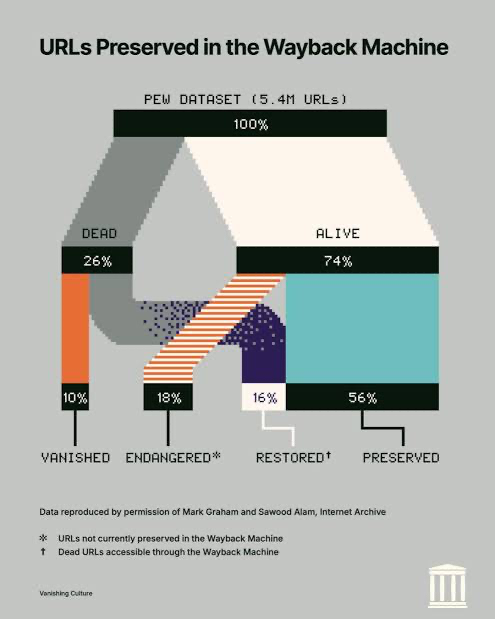
As we saw at the end of the previous instalment, the Wayback Machine recovered many of the pages that Pew Research Center had found inaccessible. In the same analysis, the Internet Archive also found that 18% of pages were “at risk”: still live, but not yet saved by anyone. It concluded its report with the message “See Something, Save Something.”
Zittrain sees it as no coincidence that an individual citizen stepped forward rather than an established institution. No institution had been willing to take on the legal risks of crawling and storing the web.
Korea, incidentally, has an institution legally entrusted with this task. The National Library of Korea has collected the Korean web under the name OASIS since 2004. By the end of 2022, it had preserved 2.45 million web resources—including websites and reports and journals published only online—of which 1.01 million were websites.
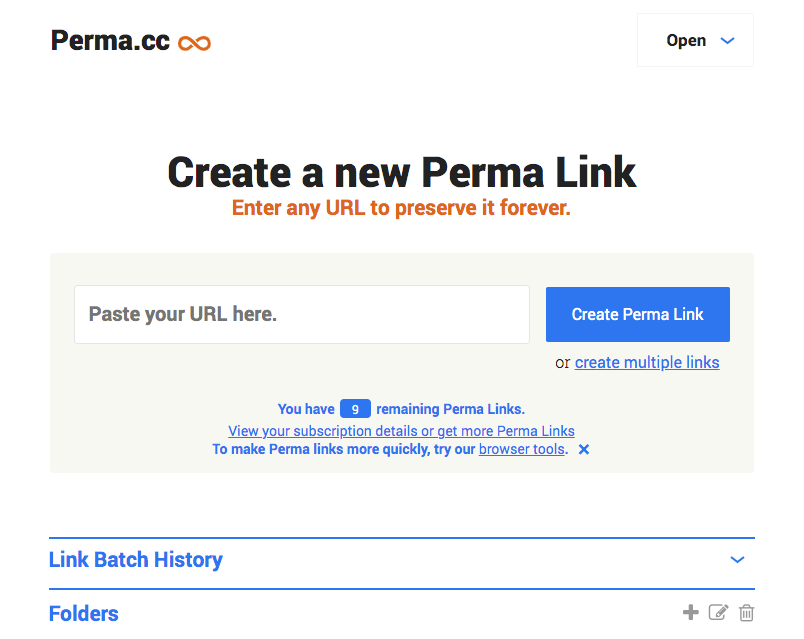
The three researchers, including Zittrain, also proposed a solution alongside their findings: Perma.cc, the permanent-link preservation service from Harvard Law School’s Library Innovation Lab.
Where the Wayback Machine sweeps broadly across the web to save pages, Perma.cc lets the person citing a page save it directly. When that person presses the save button, participating libraries—currently about 150—share custody of a copy of that address at that moment, and the service returns a permanent address that opens even if the original dies. It is the same idea as LOCKSS, discussed in the previous instalment.
Preserving anything takes someone’s labour and money. The Internet Archive is responsible for most of the preservation of the modern web’s records, yet its annual revenue in 2024 was only a little over USD 27 million, comparable to a single midsized company. Decades of the web’s memory depend on a very small sum.
🧭 Closing thoughts
In the third volume of Liu Cixin’s The Three-Body Problem trilogy, humanity faces an existential crisis and decides to leave a record of its magnificent civilisation in the universe. After agonising over a recording method that could last hundreds of millions or billions of years, the solution it ultimately chooses is to carve words into stone.
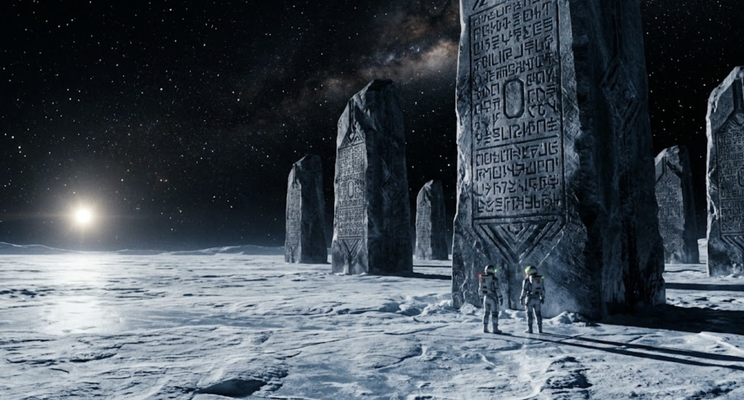
Memory has always been labour. Records without monks to copy them, stonemasons to carve them or librarians to guard the stacks have already vanished beyond retrieval. Digital technology seemed to have eliminated that labour, but in fact it had merely moved it out of sight.
Zittrain closes his 2021 essay this way:
"Society can't understand itself if it can't be honest with itself, and it can't be honest with itself if it can only live in the present moment."
A society cannot understand itself unless it is honest with itself, and it cannot be honest with itself if it lives only in the present.
Preservation is not for the people reading now. It is for the future. Only then will we know which records turn out to matter. What we can do now is work hard to protect the past.
#BetweenTechAndRules #MemoryIsLabour #DigitalPreservation #InternetArchive #LinkRot #Records